JEE Advanced Previous Year Questions – Practice Set 4
Practice Set 4 is the hardest of our four JEE Advanced sets. It has several one-or-more-correct questions, where a single wrong option costs marks, on collisions, kinetic theory of gases, nuclear chemistry and states of matter.
It also covers modern physics, electrostatics, electrochemistry, solid state, complex numbers and applications of derivatives. Attempt it after Sets 1–3, under a timer, and check every option, not just the one you picked.
How to use this set: set a timer for about 45 minutes, attempt each question before you click “Show answer and solution”, and mark the ones you get wrong. Those chapters are your revision list for this week.
Q1 · PhysicsCentre of Mass & CollisionsJEE Advanced 2023 Paper 1One or more correct
Show answer and solution
Correct answer: A, C, D
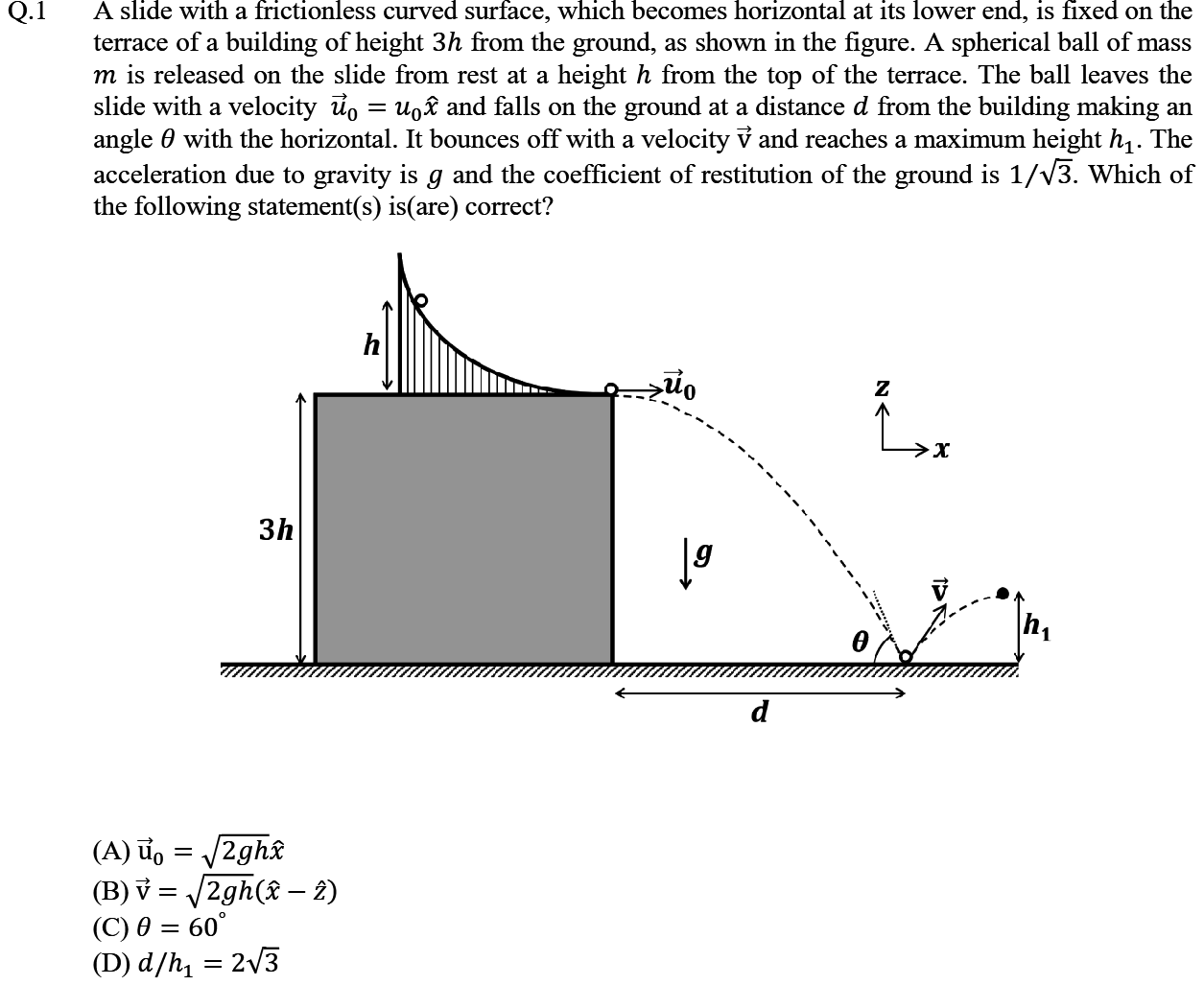
Energy conservation on the slide gives $u_0$. Then treat the fall as projectile motion, and the bounce as a collision with a smooth ground (horizontal component unchanged, normal component multiplied by $e$).
Slide: $mgh=\dfrac{1}{2}mu_0^2$ ⇒ $u_0=\sqrt{2gh}$, so $\vec u_0=\sqrt{2gh}\,\hat x$ ⇒ (A) correct
Fall through $3h$: $v_y=\sqrt{2g(3h)}=\sqrt{6gh}$ (downward)
Angle with horizontal: $\tan\theta=\dfrac{v_y}{u_0}=\dfrac{\sqrt{6gh}}{\sqrt{2gh}}=\sqrt3$ ⇒ $\theta=60^\circ$ ⇒ (C) correct
Bounce: horizontal component stays $\sqrt{2gh}$ (no friction).
Vertical component: $v_y'=e\,v_y=\dfrac{1}{\sqrt3}\sqrt{6gh}=\sqrt{2gh}$, now upward.
So $\vec v=\sqrt{2gh}\,(\hat x+\hat z)$. Option (B) has $-\hat z$, which would be downward, so (B) is incorrect. This is the trap in the question.
Max height after bounce: $h_1=\dfrac{v_y'^2}{2g}=\dfrac{2gh}{2g}=h$
Range: $t=\sqrt{\dfrac{2(3h)}{g}}=\sqrt{\dfrac{6h}{g}}$
$d=u_0t=\sqrt{2gh}\cdot\sqrt{\dfrac{6h}{g}}=\sqrt{12}\,h=2\sqrt3\,h$
$\dfrac{d}{h_1}=2\sqrt3$ ⇒ (D) correct
∴ Correct statements: (A), (C), (D)
Ans: (A), (C), (D)
Q2 · ChemistryChemical KineticsJEE Advanced 2019 Paper 2Numerical answer

Show answer and solution
Correct answer: 2.3 to 2.31
The rate constant of the reaction is defined through the unique rate, so the stoichiometric coefficient 2 must be included.
$\mathrm{Rate} = -\dfrac{1}{2}\dfrac{d[\mathrm{N_2O_5}]}{dt} = k[\mathrm{N_2O_5}]$
$\Rightarrow -\dfrac{d[\mathrm{N_2O_5}]}{dt} = 2k[\mathrm{N_2O_5}]$
At constant $V, T$, pressure is proportional to moles, so use partial pressures.
$\mathrm{2N_2O_5 \rightarrow 2N_2O_4 + O_2}$
At $t=0$: $P = 1$, $0$, $0$
At $t$: $P = 1-2x$, $2x$, $x$
$P_{total} = 1 + x = 1.45 \Rightarrow x = 0.45\ \mathrm{atm}$
$P_{\mathrm{N_2O_5}} = 1 - 2(0.45) = 0.10\ \mathrm{atm}$
Integrated first-order law:
$2kt = \ln\dfrac{P_0}{P_t}$
$2 \times 5\times10^{-4} \times t = \ln\dfrac{1}{0.1} = 2.303$
$t = \dfrac{2.303}{10^{-3}} = 2.303\times10^{3}\ \mathrm{s}$
$Y \approx 2.3$
The trap is to use $kt$ instead of $2kt$. That gives 4.6, which is wrong here.
Ans: 2.3
Q3 · MathematicsComplex NumbersJEE Advanced 2023 Paper 2Integer answer

Show answer and solution
Correct answer: 512
The product of the distances is $|z^8-2^8|$, which is maximised when $z^8$ is as far from $2^8$ as possible.
Take the circle $|z|=2$ with vertices $A_k$ at the 8th roots of $2^8$, i.e. $z^8-2^8=\prod_{k}(z-\alpha_k)$.
Let $P=z=2e^{i\theta}$.
$\prod_{k=1}^{8}PA_k=\prod_{k=1}^{8}|z-\alpha_k|=|z^8-2^8|$
⇒ $=|2^8e^{8i\theta}-2^8|=256\,|e^{8i\theta}-1|$
$|e^{8i\theta}-1|=2\,|\sin 4\theta|$, with maximum value $2$ when $|\sin4\theta|=1$.
∴ Maximum product $=256\times2=512$
Ans: 512
Q4 · PhysicsElectrostaticsJEE Advanced 2023 Paper 2Single correct

Show answer and solution
Correct answer: B
Point P is far from the charges (about 141 mm against a separation of a few mm), so the point-dipole potential applies: $V=\dfrac{k\,\vec p\cdot\hat r}{r^2}$.
Both dipoles are centred at the origin, so $r$ and $\hat r=\dfrac{(1,1)}{\sqrt2}$ are the same for both. Only $\vec p\cdot\hat r$ changes.
Take $\vec p=q\,(\vec r_+-\vec r_-)$, with lengths in mm.
Initial: $\vec p_1=q\,[(0,2)-(0,-2)]=q(0,4)$
$\vec p_1\cdot\hat r=\dfrac{4q}{\sqrt2}$ ⇒ $V_0\propto \dfrac{4q}{\sqrt2}$
Final: $\vec p_2=q\,[(-1,2)-(1,-2)]=q(-2,4)$
$\vec p_2\cdot\hat r=\dfrac{(-2+4)q}{\sqrt2}=\dfrac{2q}{\sqrt2}$
$\dfrac{V}{V_0}=\dfrac{2}{4}=\dfrac12$
Here is the catch: the dipole is tilted, so its component along $\hat r$ drops. The magnitude $|\vec p|$ is not what matters.
∴ $V=\dfrac{V_0}{2}$
Ans: (B)
Q5 · ChemistryElectrochemistryJEE Advanced 2022 Paper 2Integer answer
Show answer and solution
Correct answer: 7
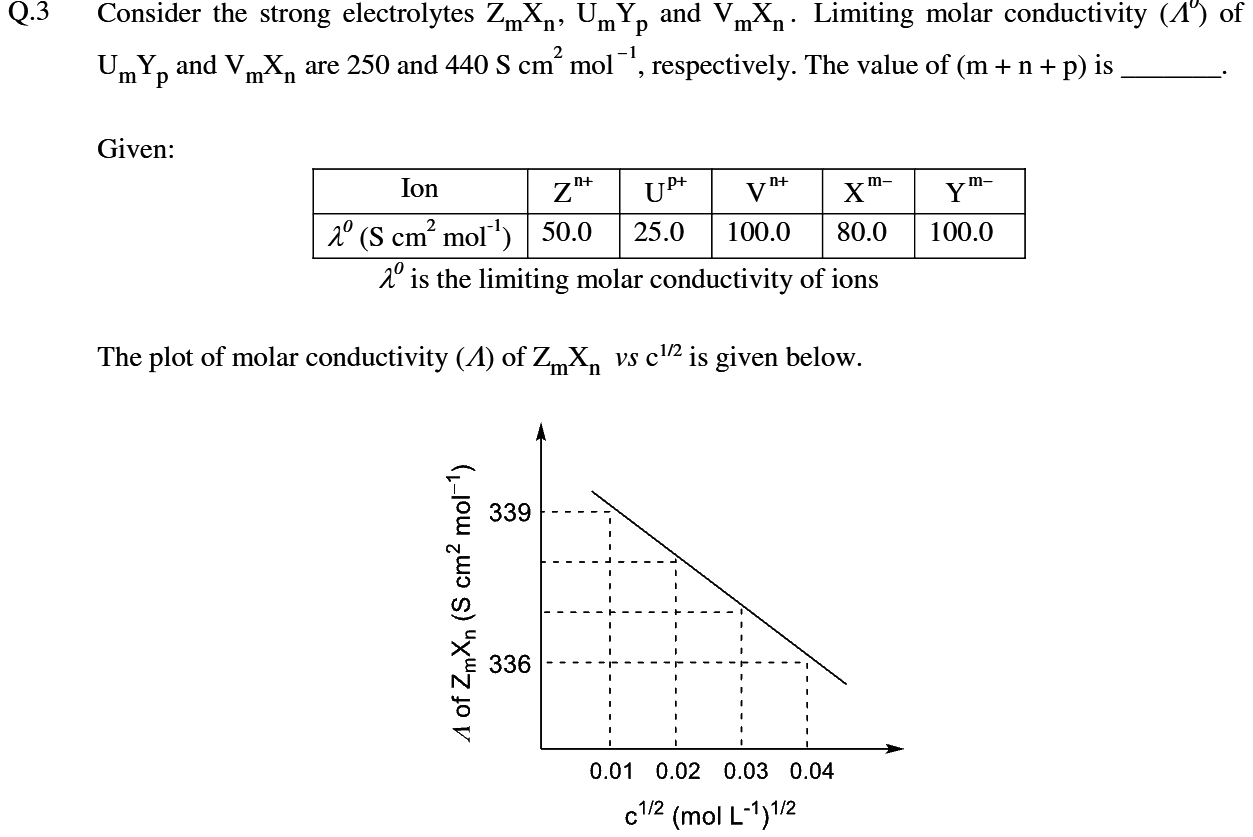
Kohlrausch's law for a strong electrolyte: $\Lambda = \Lambda^0 - A\sqrt{c}$, so the intercept of the plot gives $\Lambda^0$.
From the graph: $(0.01,\ 339)$ and $(0.04,\ 336)$
Slope: $A = \dfrac{339-336}{0.04-0.01} = 100\ \mathrm{S\,cm^2\,mol^{-1}/(mol\,L^{-1})^{1/2}}$
$\Lambda^0(\mathrm{Z_mX_n}) = 339 + 100(0.01) = 340\ \mathrm{S\,cm^2\,mol^{-1}}$
Now apply the law of independent migration of ions:
$\mathrm{Z_mX_n}$: $50m + 80n = 340$ ...(i)
$\mathrm{V_mX_n}$: $100m + 80n = 440$ ...(ii)
$\mathrm{U_mY_p}$: $25m + 100p = 250$ ...(iii)
Notice that (ii) − (i) eliminates $n$:
$50m = 100 \Rightarrow m = 2$
Put in (i): $100 + 80n = 340 \Rightarrow n = 3$
Put in (iii): $50 + 100p = 250 \Rightarrow p = 2$
$m + n + p = 2 + 3 + 2 = 7$
Ans: 7
Q6 · MathematicsDifferentiation & Applications of DerivativesJEE Advanced 2023 Paper 2Integer answer

Show answer and solution
Correct answer: 0
Since $f$ is an integral from $0$, find where $f'(x)$ changes sign.
Let $g(x)=x\tan^{-1}x$. Notice that $g(x)\ge 0$ for all $x$, because $x$ and $\tan^{-1}x$ have the same sign.
By Leibniz rule, $f'(x)=\dfrac{e^{\,g-\cos g}}{1+g^{2023}}\cdot g'(x)$
Here $g'(x)=\tan^{-1}x+\dfrac{x}{1+x^2}$
Since $g\ge0$, we get $1+g^{2023}>0$, and $e^{(\cdots)}>0$. So the sign of $f'$ is the sign of $g'(x)$.
For $x>0$, both terms of $g'$ are positive ⇒ $f'>0$.
For $x<0$, both terms are negative ⇒ $f'<0$.
At $x=0$, $g'(0)=0$.
So $f$ decreases on $(-\infty,0)$ and increases on $(0,\infty)$, and the minimum is at $x=0$.
$f(0)=\displaystyle\int_0^{0}\dfrac{e^{(t-\cos t)}}{1+t^{2023}}\,dt=0$
∴ Minimum value $=0$
Ans: 0
Q7 · PhysicsKinetic Theory of GasesJEE Advanced 2017 Paper 1One or more correct
Show answer and solution
Correct answer: A, B, D
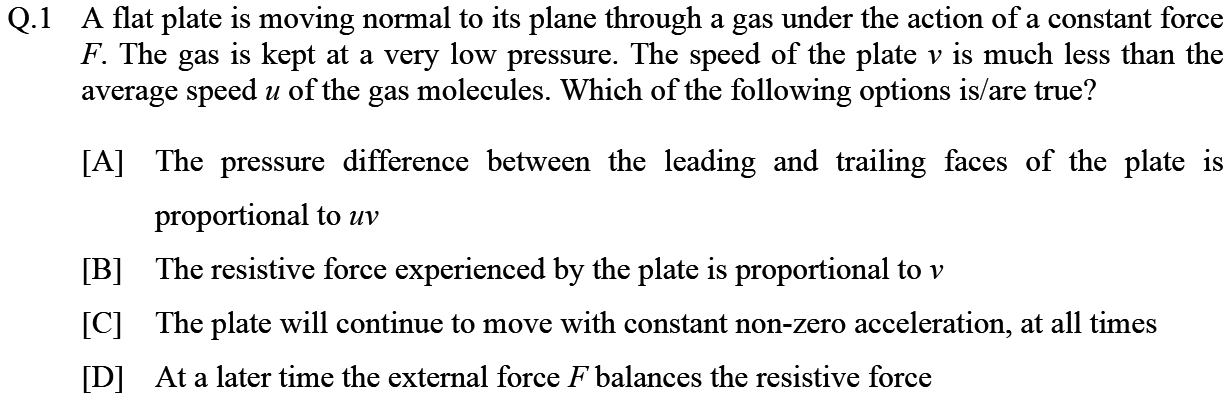
Work in the plate's frame: a molecule hitting the leading face has relative speed $(u+v)$, and one hitting the trailing face has $(u-v)$.
Low pressure means molecules hit the plate without colliding with each other, and each hit is roughly an elastic rebound.
Pressure on a face $\propto$ (rate of collisions) × (momentum change per hit) $\propto (\text{relative speed})^2$.
$P_{lead}-P_{trail}\propto (u+v)^2-(u-v)^2=4uv$
⇒ (A) correct
$\Delta P\cdot A\propto uv$ with $u$ fixed, so $F_{res}\propto v$
⇒ (B) correct
$F_{net}=F-F_{res}=F-kv$, so $a=\dfrac{F-kv}{m}$
Here is the catch: as $v$ rises, $a$ falls, so the acceleration is not constant.
⇒ (C) incorrect
When $v=\dfrac{F}{k}$, $a=0$ (terminal speed), so $F=F_{res}$ at a later time.
⇒ (D) correct
Ans: (A), (B), (D)
Q8 · ChemistryNuclear ChemistryJEE Advanced 2016 Paper 1One or more correct

Show answer and solution
Correct answer: B, D
This is JEE Advanced 2016. The nucleus has N/P < 1, so it has too many protons (neutron-poor). It must raise N/P by converting a proton into a neutron.
Notice the stable-belt trend: N/P ≥ 1 for stable nuclei, and N/P rises above 1 for Z > 20. So N/P < 1 is well below the belt.
Modes that lower the proton count and raise N/P:
$\mathrm{_1^1p \rightarrow {}_0^1n + {}_{+1}^{0}e}$ (β⁺ emission)
$\mathrm{_1^1p + {}_{-1}^{0}e \rightarrow {}_0^1n}$ (K-electron capture)
(A) β⁻ turns n into p, so N/P falls further ⇒ wrong
(B) K-capture turns p into n, so N/P rises ⇒ correct
(C) Neutron emission lowers N, so N/P falls further ⇒ wrong. It is also for neutron-rich nuclei
(D) β⁺ turns p into n, so N/P rises ⇒ correct
The trap is option (A): β⁻ is the mode for N/P above the belt, not below it.
Ans: (B), (D)
Q9 · MathematicsPermutations & CombinationsJEE Advanced 2020 Paper 2Numerical answer

Show answer and solution
Correct answer: 1080
Six persons in four rooms, each room holding 1 or 2, so the only possible distribution is 2, 2, 1, 1.
Total must be 6, and the room-wise possibilities are limited to 2+2+1+1.
Choose which 2 rooms get two persons: $^4C_2=6$
Now fill the rooms (rooms are distinct, so people go to specific rooms):
Persons for the first double room: $^6C_2=15$
Persons for the second double room: $^4C_2=6$
Persons for the first single room: $^2C_1=2$
Persons for the last single room: $^1C_1=1$
Arrangements for a fixed choice of rooms: $15\times6\times2\times1=180$
Alternatively, $\dfrac{6!}{2!\,2!\,1!\,1!}=180$
Total: $6\times180=1080$
∴ Number of ways $=1080$
Ans: 1080
Q10 · PhysicsModern PhysicsJEE Advanced 2023 Paper 2Integer answer

Show answer and solution
Correct answer: 16
Activity halves after every half-life, and both sources start with the same $A_0$.
Formula: $A = A_0\left(\dfrac{1}{2}\right)^n$, where $n$ = number of half-lives completed.
For $S_1$: $n=3$, so $A_1 = \dfrac{A_0}{2^3} = \dfrac{A_0}{8}$
For $S_2$: $n=7$, so $A_2 = \dfrac{A_0}{2^7} = \dfrac{A_0}{128}$
Now take the ratio, since $A_0$ cancels (same initial activity):
$\dfrac{A_1}{A_2} = \dfrac{128}{8} = 16$
The half-lives of $S_1$ and $S_2$ need not be equal, but this does not matter. The ratio depends only on the number of half-lives completed, not on the time elapsed.
∴ $\dfrac{A_1}{A_2} = 16$
Ans: 16
Q11 · ChemistrySolid StateJEE Advanced 2022 Paper 2Single correct

Show answer and solution
Correct answer: B
Atoms of X at the fcc sites and at alternate tetrahedral voids give a diamond-like arrangement (zinc blende with identical atoms).
Atoms per cell:
fcc sites: $8\times\frac18+6\times\frac12=4$
alternate tetrahedral voids: $4$
Total $Z = 8$
Atoms touch along the fcc site to tetrahedral void line, which is $\frac14$ of the body diagonal.
$2r=\dfrac{\sqrt3\,a}{4}\Rightarrow r=\dfrac{\sqrt3\,a}{8}$
The fcc–fcc distance is $a/\sqrt2=0.707a$, which is greater than $2r=0.433a$.
∴ fcc atoms do not touch each other, so the contact above is the correct one.
$\text{P.E.}=\dfrac{8\times\frac43\pi r^3}{a^3}=\dfrac{8\times\frac43\pi\times\frac{3\sqrt3\,a^3}{512}}{a^3}$
$\text{P.E.}=\dfrac{\sqrt3\,\pi}{16}=\dfrac{5.44}{16}\approx0.34$
≈ 34 %, closest to 35.
Ans: (B)
Q12 · MathematicsSets, Relations & FunctionsJEE Advanced 2020 Paper 2Numerical answer
Show answer and solution
Correct answer: 19
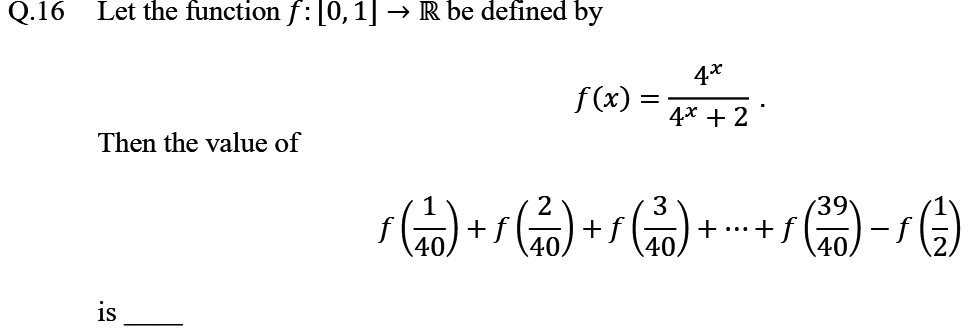
Pair the terms $f(x)$ and $f(1-x)$, since their sum is likely constant.
$f(x)+f(1-x)=\dfrac{4^x}{4^x+2}+\dfrac{4^{1-x}}{4^{1-x}+2}$
Now $\dfrac{4^{1-x}}{4^{1-x}+2}=\dfrac{4}{4+2\cdot 4^x}=\dfrac{2}{2+4^x}$
⇒ $f(x)+f(1-x)=\dfrac{4^x+2}{4^x+2}=1$
The sum has terms $k=1$ to $39$, and $k$ pairs with $40-k$ (since $\dfrac{k}{40}+\dfrac{40-k}{40}=1$).
So the 39 terms form 19 pairs, and the middle term $f\left(\dfrac{20}{40}\right)=f\left(\dfrac12\right)$ is left over.
$\displaystyle\sum_{k=1}^{39} f\left(\dfrac{k}{40}\right)=19(1)+f\left(\dfrac12\right)$
This is where the subtracted $f\left(\dfrac12\right)$ cancels the leftover middle term.
∴ Value $=19+f\left(\dfrac12\right)-f\left(\dfrac12\right)=19$
Ans: 19
Q13 · PhysicsThermal Properties & CalorimetryJEE Advanced 2020 Paper 2Numerical answer

Show answer and solution
Correct answer: 8.32 to 8.34
After a long time the water reaches steady state, so heat absorbed per second equals heat lost per second.
Power absorbed: $P = 700\times0.05 = 35\ \mathrm{W}$
Newton's law of cooling: $\dfrac{dQ}{dt}=k\,m s\,\Delta T$, where $k=0.001\ \mathrm{s^{-1}}$. Note that $k$ multiplies $ms\,\Delta T$, so the unit of the loss rate comes out in W.
Given: $m=1\ \mathrm{kg}$, $s=4200\ \mathrm{J\,kg^{-1}K^{-1}}$, $k=0.001\ \mathrm{s^{-1}}$
Steady state: $\dfrac{dT}{dt}=0$, so $P = k\,ms\,\Delta T$
$35 = 0.001\times1\times4200\times\Delta T$
$35 = 4.2\,\Delta T$
$\Delta T=\dfrac{35}{4.2}=8.33\ ^\circ\mathrm{C}$
∴ $\Delta T \approx 8.33\ ^\circ\mathrm{C}$
Ans: 8.33
Q14 · ChemistryStates of MatterJEE Advanced 2020 Paper 1One or more correct
Show answer and solution
Correct answer: A, B, C
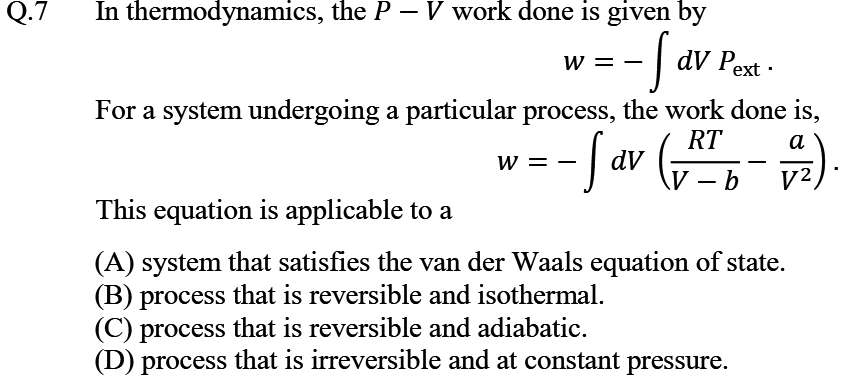
Work equals $-\int P_{ext}\,dV$, so the integrand must be $P_{ext}$. Here it is the van der Waals pressure of the gas.
$\mathrm{P_{vdW} = \dfrac{RT}{V-b} - \dfrac{a}{V^2}}$ (for 1 mol)
The integrand is the gas's own pressure, so the system obeys the vdW equation ⇒ (A) correct.
The gas pressure equals $P_{ext}$ only if the process is reversible, so $P_{ext} = P_{int}$ ⇒ reversible process.
This is where most students slip: the expression does not force T to be constant. In the integral T can vary with V.
(B) Reversible isothermal: $T$ constant, $P_{ext} = P_{vdW}$ ⇒ valid.
(C) Reversible adiabatic: $T$ changes with $V$, but $P_{ext} = P_{vdW}$ still holds at each step ⇒ valid.
(D) Irreversible, constant pressure: $w = -P_{ext}\Delta V$, and $P_{ext} \ne P_{vdW}$ at every stage ⇒ not valid.
Ans: (A), (B), (C)
Q15 · Mathematics3D GeometryJEE Advanced 2019 Paper 1Numerical answer
Show answer and solution
Correct answer: 0.75
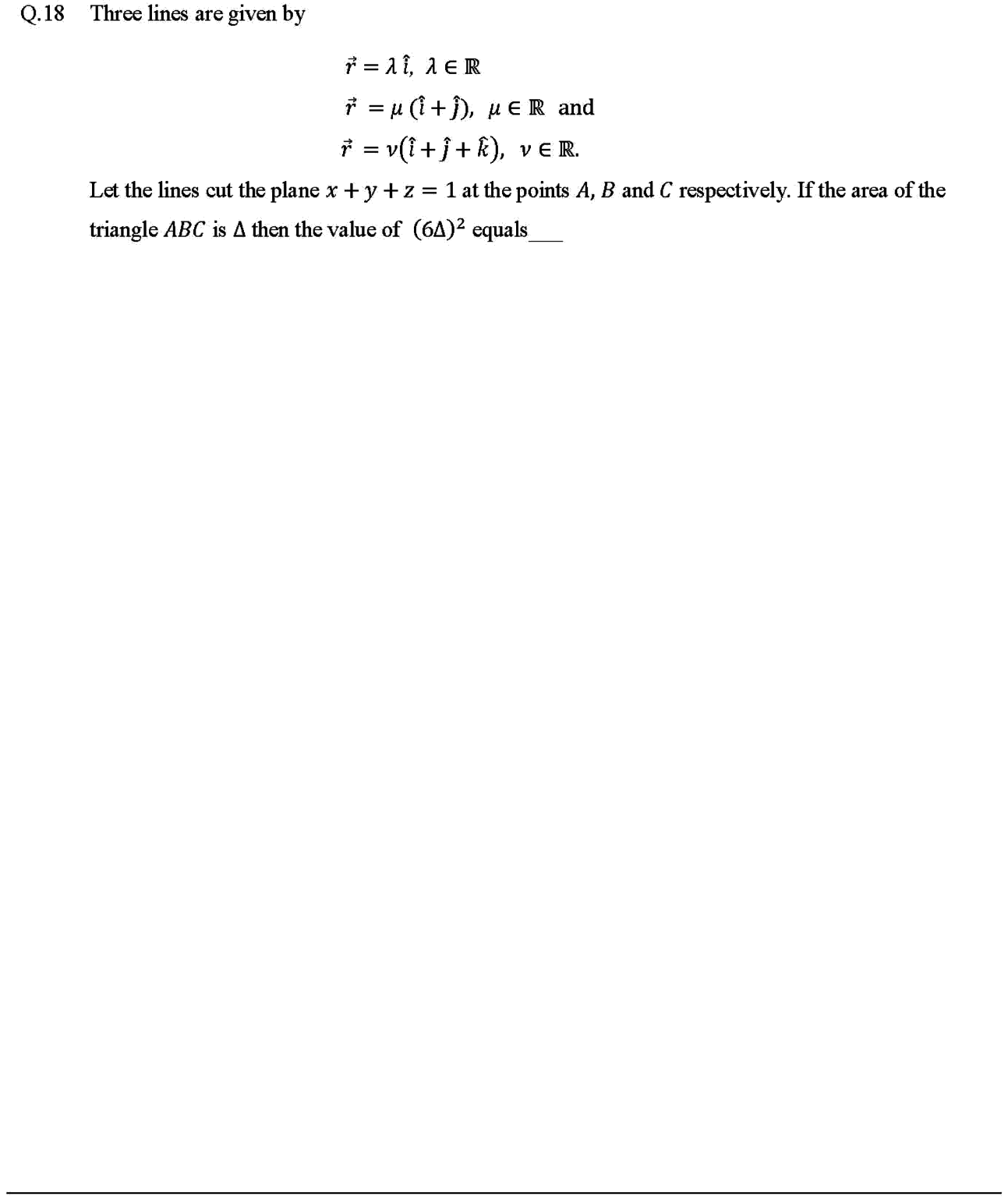
Each line passes through the origin, so substitute its general point into the plane to find A, B and C.
A: $(\lambda,0,0)$ ⇒ $\lambda=1$ ⇒ $A=(1,0,0)$
B: $(\mu,\mu,0)$ ⇒ $2\mu=1$ ⇒ $B=\left(\dfrac{1}{2},\dfrac{1}{2},0\right)$
C: $(\nu,\nu,\nu)$ ⇒ $3\nu=1$ ⇒ $C=\left(\dfrac{1}{3},\dfrac{1}{3},\dfrac{1}{3}\right)$
Area of triangle: $\Delta=\dfrac{1}{2}\left|\overrightarrow{AB}\times\overrightarrow{AC}\right|$
$\overrightarrow{AB}=\left(-\dfrac{1}{2},\dfrac{1}{2},0\right)$, $\overrightarrow{AC}=\left(-\dfrac{2}{3},\dfrac{1}{3},\dfrac{1}{3}\right)$
Cross product:
$i$: $\dfrac{1}{2}\cdot\dfrac{1}{3}-0=\dfrac{1}{6}$
$j$: $-\left(-\dfrac{1}{2}\cdot\dfrac{1}{3}-0\right)=\dfrac{1}{6}$
$k$: $-\dfrac{1}{2}\cdot\dfrac{1}{3}-\dfrac{1}{2}\cdot\left(-\dfrac{2}{3}\right)=-\dfrac{1}{6}+\dfrac{1}{3}=\dfrac{1}{6}$
⇒ $\overrightarrow{AB}\times\overrightarrow{AC}=\dfrac{1}{6}(1,1,1)$, $\left|\ \right|=\dfrac{\sqrt3}{6}$
$\Delta=\dfrac{\sqrt3}{12}$ ⇒ $6\Delta=\dfrac{\sqrt3}{2}$
∴ $(6\Delta)^2=\dfrac{3}{4}=0.75$
Ans: 0.75