JEE Advanced Previous Year Questions – Practice Set 2
Practice Set 2 covers the widest spread of chapters among our JEE Advanced sets. In Physics it goes from vector basics to electromagnetic induction and ray optics; in Chemistry from chemical bonding and thermodynamics to qualitative salt analysis; in Mathematics from quadratic equations to definite integration and area.
It mixes integer, numerical, single-correct and multiple-correct formats, so it is a good set to check whether you can switch between question styles the way the real paper forces you to.
How to use this set: set a timer for about 45 minutes, attempt each question before you click “Show answer and solution”, and mark the ones you get wrong. Those chapters are your revision list for this week.
Q1 · PhysicsBasic MathematicsJEE Advanced 2018 Paper 1Numerical answer

Show answer and solution
Correct answer: 2
Both vectors have magnitude $a$, and the angle between them is $\theta=\omega t$. So use the magnitude formulas for a sum and a difference.
Given: $|\vec A|=|\vec B|=a$, $\omega=\dfrac{\pi}{6}\ \mathrm{rad\,s^{-1}}$
Formula: $|\vec A+\vec B|=2a\cos\dfrac{\theta}{2}$, $|\vec A-\vec B|=2a\sin\dfrac{\theta}{2}$
Condition: $2a\cos\dfrac{\theta}{2}=\sqrt3\,(2a\sin\dfrac{\theta}{2})$
⇒ $\tan\dfrac{\theta}{2}=\dfrac{1}{\sqrt3}$
⇒ $\dfrac{\theta}{2}=\dfrac{\pi}{6}$ for the first time, so $\theta=\dfrac{\pi}{3}$
Now $\theta=\omega\tau$, so $\tau=\dfrac{\pi/3}{\pi/6}=2\ \mathrm{s}$
Check by squaring: $|\vec A+\vec B|^2=2a^2(1+\cos\theta)$ and $|\vec A-\vec B|^2=2a^2(1-\cos\theta)$.
$1+\cos\theta=3(1-\cos\theta)$ ⇒ $\cos\theta=\dfrac12$ ⇒ $\theta=\dfrac{\pi}{3}$, the same result.
∴ $\tau=2\ \mathrm{s}$
Ans: 2
Q2 · ChemistryChemical BondingJEE Advanced 2022 Paper 2Integer answer

Show answer and solution
Correct answer: 6
Thermal decomposition of $\mathrm{AgNO_3}$ gives the two paramagnetic gases, so first identify them.
$\mathrm{2AgNO_3 \xrightarrow{\Delta} 2Ag + 2NO_2 + O_2}$
$\mathrm{NO_2}$: odd-electron molecule, 1 unpaired electron
$\mathrm{O_2}$: 2 unpaired electrons (in $\pi^*2p_x$ and $\pi^*2p_y$)
So the gas with more unpaired electrons is $\mathrm{O_2}$.
Now write the MO configuration of $\mathrm{O_2}$ (16 electrons). The question says "antibonding molecular orbitals", so count all of them, including the $1s$ set.
$\sigma 1s^2\ \sigma^*1s^2\ \sigma 2s^2\ \sigma^*2s^2\ \sigma 2p_z^2\ \pi 2p_x^2\ \pi 2p_y^2\ \pi^*2p_x^1\ \pi^*2p_y^1$
Antibonding electrons:
$\sigma^*1s = 2$
$\sigma^*2s = 2$
$\pi^*2p_x,\ \pi^*2p_y = 1 + 1 = 2$
Total = $2 + 2 + 2 = 6$
Check: the bonding electrons are $2 + 2 + 2 + 4 = 10$, and $10 + 6 = 16$ ✓.
The catch: counting only the valence $\pi^*$ electrons gives 2, and counting $\sigma^*2s$ as well gives 4. Both are wrong here, because the $\sigma^*1s$ electrons also belong to an antibonding MO.
Ans: 6
Q3 · MathematicsBinomial TheoremJEE Advanced 2023 Paper 1Integer answer

Show answer and solution
Correct answer: 3
Use the general term $T_{r+1}={}^nC_r\,(\text{first})^{n-r}(\text{second})^r$ for each expansion and match the powers of $x$.
First expansion: $T_{r+1}={}^4C_r\,(ax^2)^{4-r}\left(\dfrac{70}{27bx}\right)^r$
Power of $x$: $8-2r-r=8-3r=5$ ⇒ $r=1$
Coefficient: $4\,a^3\cdot\dfrac{70}{27b}=\dfrac{280a^3}{27b}$
Second expansion: $T_{r+1}={}^7C_r\,(ax)^{7-r}\left(-\dfrac{1}{bx^2}\right)^r$
Power of $x$: $7-r-2r=7-3r=-5$ ⇒ $r=4$
Coefficient: $^7C_4\,a^3\cdot\dfrac{1}{b^4}=\dfrac{35a^3}{b^4}$ (the sign is $+$ since $r=4$ is even)
Equate the coefficients and cancel $a^3$ (as $a\neq 0$):
$\dfrac{280}{27b}=\dfrac{35}{b^4}$
⇒ $b^3=\dfrac{35\cdot 27}{280}=\dfrac{27}{8}$
⇒ $b=\dfrac{3}{2}$
∴ $2b=3$
Ans: 3
Q4 · PhysicsElectromagnetic Induction & ACJEE Advanced 2023 Paper 2Integer answer
Show answer and solution
Correct answer: 4
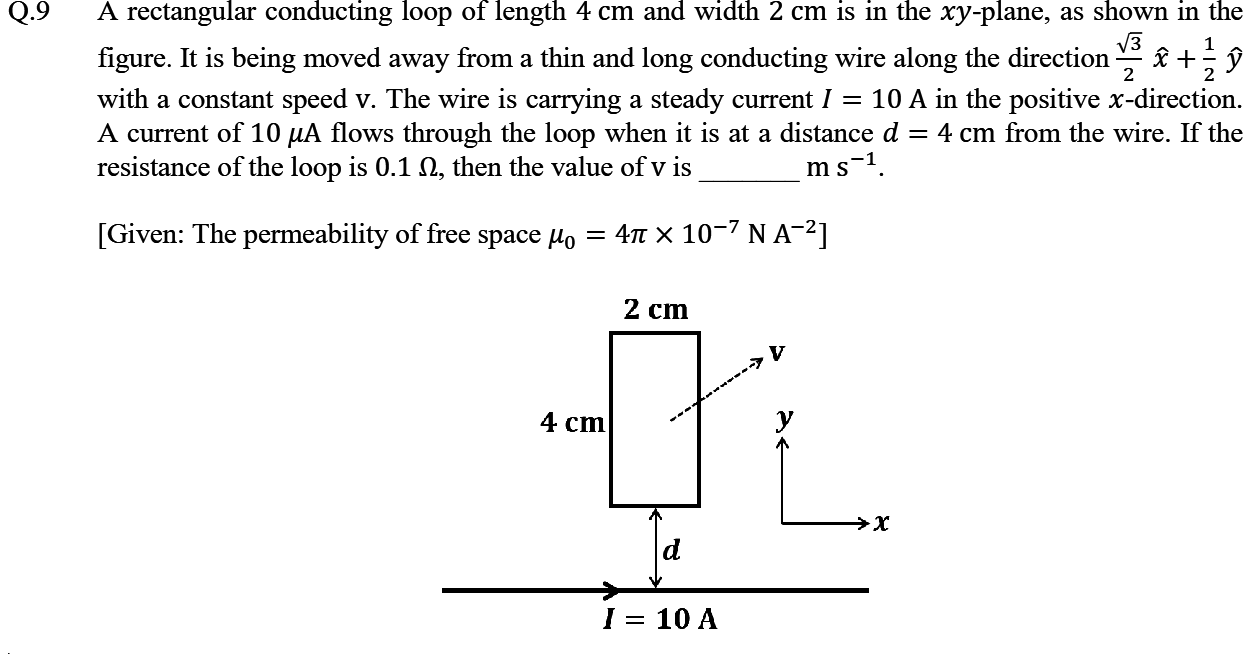
Only the velocity component perpendicular to the wire changes the flux, so first find that component.
Concept: Motional emf from the changing flux through the loop; only $v_y$ changes the distance from the wire.
Given: $a=2\ \mathrm{cm}$ (side parallel to wire), $b=4\ \mathrm{cm}$ (side along $y$), $d=4\ \mathrm{cm}$, $I=10\ \mathrm{A}$, $i=10\ \mu\mathrm{A}$, $R=0.1\ \Omega$
Take $y$ as the direction away from the wire, so $\dfrac{dd}{dt}=v_y=v\sin30^\circ=\dfrac{v}{2}$
Flux: $\phi=\dfrac{\mu_0 I a}{2\pi}\ln\dfrac{d+b}{d}$
$\varepsilon=\left|\dfrac{d\phi}{dt}\right|=\dfrac{\mu_0 I a}{2\pi}\left[\dfrac{1}{d}-\dfrac{1}{d+b}\right]\dfrac{v}{2}=\dfrac{\mu_0 I a}{2\pi}\,\dfrac{b}{d(d+b)}\,\dfrac{v}{2}$
Substitute (SI units):
$\dfrac{\mu_0 I a}{2\pi}=2\times10^{-7}\times10\times0.02=4\times10^{-8}$
$\dfrac{b}{d(d+b)}=\dfrac{0.04}{0.04\times0.08}=12.5\ \mathrm{m^{-1}}$
$\varepsilon=4\times10^{-8}\times12.5\times\dfrac{v}{2}=2.5\times10^{-7}\,v$
Also $\varepsilon=iR=10\times10^{-6}\times0.1=10^{-6}\ \mathrm{V}$
$v=\dfrac{10^{-6}}{2.5\times10^{-7}}=4\ \mathrm{m\,s^{-1}}$
Common trap: using the full $v$ instead of $v/2$. The $x$-component does not change the flux, because the field is uniform along $x$.
∴ $v=4\ \mathrm{m\,s^{-1}}$
Ans: 4
Q5 · ChemistryChemical ThermodynamicsJEE Advanced 2017 Paper 2Single correct
Show answer and solution
Correct answer: A
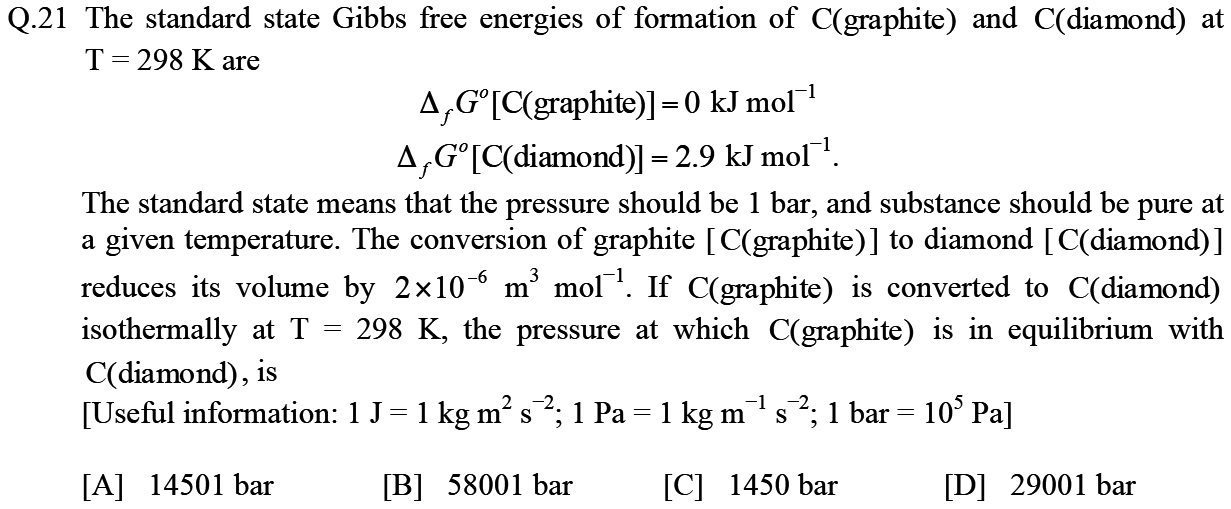
Graphite → diamond has ΔG° = +2900 J at 1 bar. Pressure must shift ΔG to zero, using (∂G/∂P)_T = ΔV.
Formula: $\Delta G(P) = \Delta G^\circ + \Delta V\,(P - P^\circ)$ (ΔV taken constant, solids)
Given: $\Delta G^\circ = 2900\ \mathrm{J\,mol^{-1}}$, $\Delta V = -2\times10^{-6}\ \mathrm{m^3\,mol^{-1}}$, $P^\circ = 1\ \mathrm{bar}$
At equilibrium $\Delta G = 0$:
$0 = 2900 + (-2\times10^{-6})(P - 10^5)$
$P - 10^5 = \dfrac{2900}{2\times10^{-6}} = 1.45\times10^{9}\ \mathrm{Pa}$
$P = 1.45\times10^{9} + 10^5 \approx 1.4501\times10^{9}\ \mathrm{Pa}$
$P = \dfrac{1.4501\times10^{9}}{10^5} = 14501\ \mathrm{bar}$
Trap: forgetting to add the 1 bar gives 14500 bar. Option (C) 1450 bar comes from a Pa/bar slip.
Ans: (A)
Q6 · MathematicsDefinite Integration & AreaJEE Advanced 2021 Paper 2Numerical answer

Show answer and solution
Correct answer: 1.5
Shift to the midpoint $\dfrac{\pi}{4}$ of the interval, so that $|4x-\pi|$ becomes $4|t|$ and symmetry can be used.
$S_2=\displaystyle\int_{\pi/8}^{3\pi/8}\sin^2x\,|4x-\pi|\,dx$
Let $x=\dfrac{\pi}{4}+t$, so $t\in\left[-\dfrac{\pi}{8},\dfrac{\pi}{8}\right]$
⇒ $|4x-\pi|=4|t|$
$\sin^2x=\dfrac{1-\cos 2x}{2}=\dfrac{1-\cos\left(\frac{\pi}{2}+2t\right)}{2}=\dfrac{1+\sin 2t}{2}$
⇒ $S_2=\displaystyle\int_{-\pi/8}^{\pi/8}2|t|\,(1+\sin 2t)\,dt$
$|t|\sin 2t$ is odd, so that part vanishes over the symmetric limits.
⇒ $S_2=2\displaystyle\int_{-\pi/8}^{\pi/8}|t|\,dt=4\int_0^{\pi/8}t\,dt=4\cdot\dfrac{1}{2}\cdot\dfrac{\pi^2}{64}=\dfrac{\pi^2}{32}$
∴ $\dfrac{48S_2}{\pi^2}=\dfrac{48}{32}=\dfrac{3}{2}$
Ans: 1.5
Q7 · PhysicsGravitationJEE Advanced 2023 Paper 1Single correct
Show answer and solution
Correct answer: A
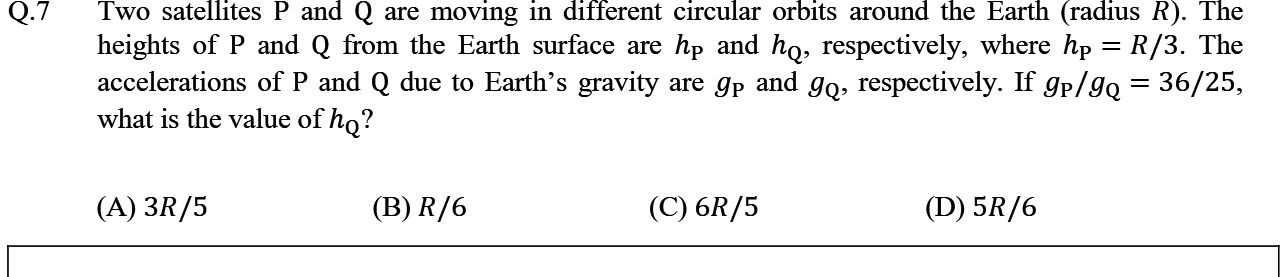
g at height h varies as the inverse square of the distance from Earth's centre, so the ratio $g_P/g_Q$ fixes $h_Q$.
$g=\dfrac{GM}{(R+h)^2}$
$\dfrac{g_P}{g_Q}=\dfrac{(R+h_Q)^2}{(R+h_P)^2}=\dfrac{36}{25}$
Take the square root, since distances are positive: $\dfrac{R+h_Q}{R+h_P}=\dfrac{6}{5}$
Given $h_P=\dfrac{R}{3}$ ⇒ $R+h_P=\dfrac{4R}{3}$
$R+h_Q=\dfrac{6}{5}\times\dfrac{4R}{3}=\dfrac{8R}{5}$
$h_Q=\dfrac{8R}{5}-R=\dfrac{3R}{5}$
The trap is to take the ratio of heights directly instead of the ratio of distances from the centre.
∴ $h_Q=\dfrac{3R}{5}$
Ans: (A)
Q8 · ChemistryIonic EquilibriumJEE Advanced 2022 Paper 1Numerical answer

Show answer and solution
Correct answer: 10.02
NaOH is a strong base, so it reacts first with the strongest acid present, $\mathrm{H_2CO_3}$.
$\mathrm{H_2CO_3 + NaOH \rightarrow NaHCO_3 + H_2O}$
Moles: $0.01 + 0.01 \rightarrow 0.01$ of $\mathrm{NaHCO_3}$ formed, and both reactants are used up.
Now the mixture holds:
$\mathrm{NaHCO_3} = 0.01 + 0.01 = 0.02\ mol$
$\mathrm{Na_2CO_3} = 0.01\ mol$
So an $\mathrm{HCO_3^-/CO_3^{2-}}$ buffer remains. Here $\mathrm{pK_{a2}}$ is the one to use, since $\mathrm{HCO_3^-}$ is the acid and $\mathrm{CO_3^{2-}}$ is its conjugate base. The trap is to use $\mathrm{pK_{a1}}$.
Formula: $\mathrm{pH} = \mathrm{p}K_{a2} + \log\dfrac{[\mathrm{CO_3^{2-}}]}{[\mathrm{HCO_3^-}]}$
Volume is the same for both species, so the mole ratio can be used directly.
$\mathrm{pH} = 10.32 + \log\dfrac{0.01}{0.02}$
$\mathrm{pH} = 10.32 - \log 2 = 10.32 - 0.30$
$\mathrm{pH} = 10.02$
Ans: 10.02
Q9 · MathematicsMathematical Reasoning & LogicJEE Advanced 2019 Paper 2Single correct
Show answer and solution
Correct answer: C
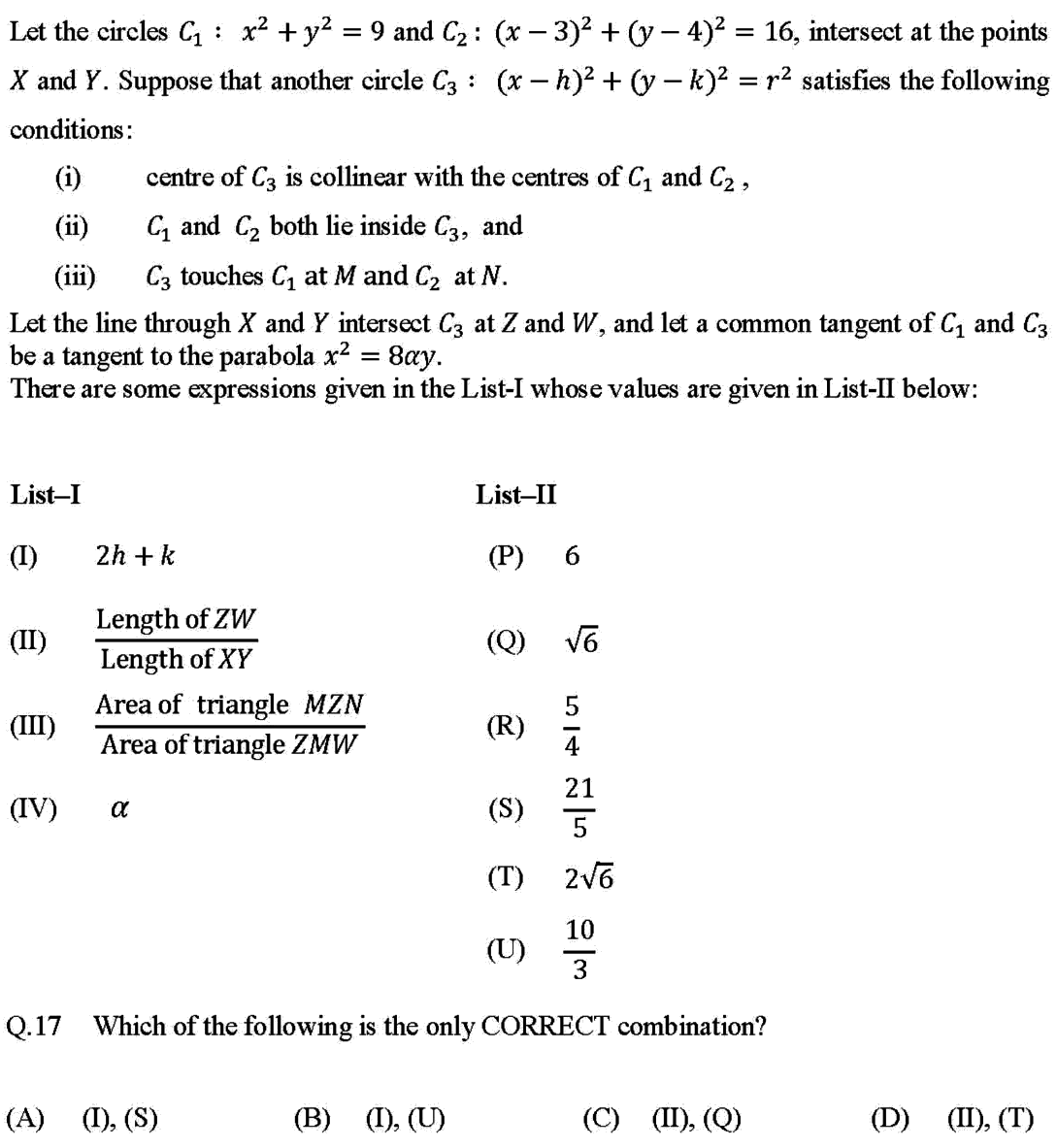
Two circles touching internally means the distance between centres equals the difference of radii. Use this to find $C_3$, then the radical axis for $XY$.
$C_1$: centre $O(0,0)$, $r_1=3$. $C_2$: centre $A(3,4)$, $r_2=4$. Centre $P(h,k)$ of $C_3$ lies on $OA$: $y=\dfrac{4}{3}x$.
$C_3$ contains both circles and touches each internally.
⇒ $OP=r-3$, $AP=r-4$, and $OP+AP=OA=5$
⇒ $2r-7=5$ ⇒ $r=6$, $OP=3$, $AP=2$
⇒ $P=3\left(\dfrac{3}{5},\dfrac{4}{5}\right)=\left(\dfrac{9}{5},\dfrac{12}{5}\right)$
(I): $2h+k=\dfrac{18}{5}+\dfrac{12}{5}=6$ ⇒ (P). So (I)–(S) and (I)–(U) are wrong.
Line $XY$ is the radical axis $C_1-C_2=0$. Here $C_2: x^2+y^2-6x-8y+9=0$.
⇒ $6x+8y-18=0$ ⇒ $3x+4y=9$
Distance of $O$ from $XY$ is $\dfrac{9}{5}$.
⇒ $XY=2\sqrt{9-\dfrac{81}{25}}=2\sqrt{\dfrac{144}{25}}=\dfrac{24}{5}$
Distance of $P$ from $XY$ is $\dfrac{\left|\frac{27}{5}+\frac{48}{5}-9\right|}{5}=\dfrac{6}{5}$.
⇒ $ZW=2\sqrt{36-\dfrac{36}{25}}=2\cdot\dfrac{6}{5}\sqrt{24}=\dfrac{24\sqrt6}{5}$
(II): $\dfrac{ZW}{XY}=\sqrt6$ ⇒ (Q)
∴ (II)–(Q) is the only correct combination.
Ans: (C)
Q10 · PhysicsMagnetic Effects of Current & MagnetismJEE Advanced 2018 Paper 2Numerical answer

Show answer and solution
Correct answer: 5.56
Full-scale deflection gives the galvanometer current from the torque balance, and then the shunt is found from the parallel combination.
Given: $N=50$, $A=2\times10^{-4}\ \mathrm{m^2}$, $B=0.02\ \mathrm{T}$, $k=10^{-4}\ \mathrm{N\,m\,rad^{-1}}$, $\phi=0.2\ \mathrm{rad}$, $G=50\ \Omega$, $I=1\ \mathrm{A}$
At equilibrium, magnetic torque = restoring torque:
$NI_gAB=k\phi$
$I_g=\dfrac{k\phi}{NAB}=\dfrac{10^{-4}\times0.2}{50\times2\times10^{-4}\times0.02}$
$I_g=\dfrac{2\times10^{-5}}{2\times10^{-4}}=0.1\ \mathrm{A}$
The shunt $S$ is in parallel, so the voltages are equal:
$I_gG=(I-I_g)S$
$S=\dfrac{I_gG}{I-I_g}=\dfrac{0.1\times50}{1-0.1}=\dfrac{5}{0.9}$
$S\approx5.56\ \Omega$
∴ Shunt resistance $\approx 5.56\ \Omega$
Ans: 5.56
Q11 · ChemistryQualitative AnalysisJEE Advanced 2023 Paper 1Single correct
Show answer and solution
Correct answer: C
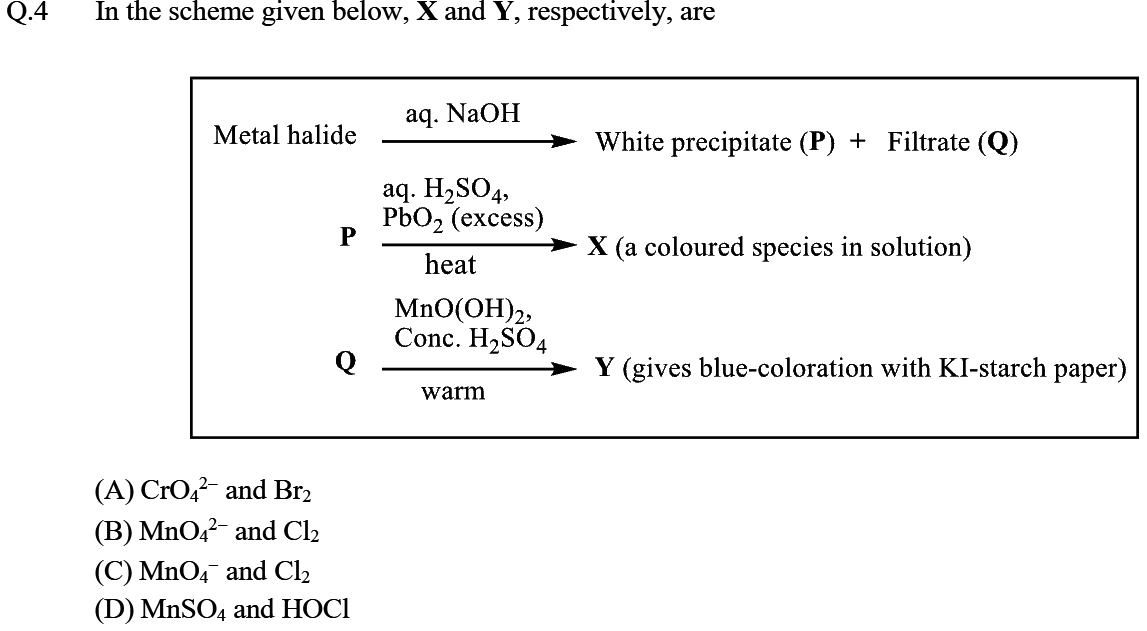
White ppt. insoluble in excess NaOH, and it must be oxidised to a coloured ion by PbO₂, so P is $\mathrm{Mn(OH)_2}$. Here is the catch: $\mathrm{Cr(OH)_3}$ is green and $\mathrm{Zn(OH)_2}$ dissolves in excess NaOH, so neither fits.
Metal halide = $\mathrm{MnCl_2}$
$\mathrm{MnCl_2 + 2NaOH \rightarrow Mn(OH)_2\downarrow\ (white,\ P) + 2NaCl\ (Q)}$
P with $\mathrm{PbO_2}$ (excess) in acid, heat: the test for $\mathrm{Mn^{2+}}$
$\mathrm{2Mn^{2+} + 5PbO_2 + 4H^+ \xrightarrow{\Delta} 2MnO_4^- + 5Pb^{2+} + 2H_2O}$
X = $\mathrm{MnO_4^-}$ (purple)
Now Q = NaCl, the chloride test with $\mathrm{MnO_2}$ and conc. $\mathrm{H_2SO_4}$:
$\mathrm{2Cl^- + MnO_2 + 4H^+ \xrightarrow{warm} Mn^{2+} + Cl_2\uparrow + 2H_2O}$
Y = $\mathrm{Cl_2}$; it liberates iodine, which turns starch blue
$\mathrm{Cl_2 + 2KI \rightarrow 2KCl + I_2}$
∴ X = $\mathrm{MnO_4^-}$, Y = $\mathrm{Cl_2}$
Ans: (C)
Q12 · MathematicsQuadratic EquationsJEE Advanced 2022 Paper 2Integer answer

Show answer and solution
Correct answer: 1
Taking $\log_5$ of both sides turns the equation into a quadratic in $t^2$, where $t=\log_5 x$.
Let $t=\log_5 x$, so $x=5^t$
$x^{(16t^3-68t)}=5^{t(16t^3-68t)}=5^{-16}$
⇒ $16t^4-68t^2=-16$
⇒ $4t^4-17t^2+4=0$
⇒ $(4t^2-1)(t^2-4)=0$
⇒ $t^2=\dfrac{1}{4}$ or $t^2=4$, so $t=\pm\dfrac12,\ \pm2$
All four values of $t$ give positive $x$, and we need the product of the $x$ values.
Product of the $x$ values $=5^{t_1+t_2+t_3+t_4}$
Sum of the $t$ values $=\dfrac12-\dfrac12+2-2=0$
∴ Product $=5^0=1$
Ans: 1
Q13 · PhysicsRay OpticsJEE Advanced 2023 Paper 1One or more correct

Show answer and solution
Correct answer: A, C, D
Brewster condition means no reflection, so tan i = μ.
Brewster incidence: $\tan i=\mu=\sqrt3\Rightarrow i=60^\circ$
Then $r_1=90^\circ-i=30^\circ$
(A) At Brewster angle the reflected light has no component in the plane of incidence. For zero reflection, the light must be polarized in the plane of incidence ⇒ correct
Now find the prism angle from the deviation.
$\delta=i+e-A\Rightarrow 60^\circ=60^\circ+e-A\Rightarrow e=A$
At the exit face: $r_2=A-30^\circ$, $\sin e=\sqrt3\sin(A-30^\circ)$
$\sin A=\sqrt3\left(\dfrac{\sqrt3}{2}\sin A-\dfrac12\cos A\right)=\dfrac32\sin A-\dfrac{\sqrt3}{2}\cos A$
$\dfrac12\sin A=\dfrac{\sqrt3}{2}\cos A\Rightarrow\tan A=\sqrt3\Rightarrow A=60^\circ$
(B) $A=60^\circ$, not $45^\circ$ ⇒ incorrect
Red light at minimum deviation, with $A=60^\circ$ and $\delta_{min}=30^\circ$:
$\mu_R=\dfrac{\sin\left(\frac{A+\delta_{min}}{2}\right)}{\sin\frac A2}=\dfrac{\sin45^\circ}{\sin30^\circ}=\dfrac{1/\sqrt2}{1/2}=\sqrt2$
(C) ⇒ correct
(D) At the exit plane for blue light, $e=A=60^\circ$ ⇒ correct. Notice the emergent ray angle in air is 60°, and the question asks for exactly this.
Ans: (A), (C), (D)
Q14 · ChemistrySolutions and Colligative PropertiesJEE Advanced 2022 Paper 2Integer answer

Show answer and solution
Correct answer: 5
Vapour pressure lowering gives the total moles of particles, so $i$ follows, and then the number of ions from the degree of dissociation.
$\dfrac{P^0 - P_s}{P^0} = \dfrac{60.000 - 59.724}{60.000} = \dfrac{0.276}{60} = 0.0046$
Moles of water: $n_{w} = \dfrac{1800}{18} = 100\ \mathrm{mol}$
Solution is dilute, so $\dfrac{\Delta P}{P^0} \approx \dfrac{n_{solute}}{n_{w}}$
$\dfrac{i \times 0.1}{100} = 0.0046 \Rightarrow i = 4.6$
For $\alpha = 0.9$ and $n$ ions per formula unit: $i = 1 + \alpha(n-1)$
$4.6 = 1 + 0.9(n-1)$
$n - 1 = \dfrac{3.6}{0.9} = 4$
$n = 5$
Check: $i = 4.6$ gives $0.46$ mol of particles, $x = \dfrac{0.46}{100.46} = 0.00458$, so $P_s \approx 59.725$ mm Hg, which matches the given value.
Ans: 5
Q15 · MathematicsTrigonometryJEE Advanced 2023 Paper 2Single correct

Show answer and solution
Correct answer: C
Since $0<|y|<3$, we have $9-y^2>0$, so the sign of $\dfrac{9-y^2}{6y}$ depends on $y$. The cot$^{-1}$ conversion therefore needs two cases.
Let $t=\dfrac{6y}{9-y^2}$. Then $\cot^{-1}\left(\dfrac{1}{t}\right)=\tan^{-1}t$ if $t>0$, and $\pi+\tan^{-1}t$ if $t<0$.
Case $0<y<3$: here $t>0$
⇒ $2\tan^{-1}t=\dfrac{2\pi}{3}$
⇒ $t=\tan\dfrac{\pi}{3}=\sqrt3$
⇒ $6y=\sqrt3\,(9-y^2)$
⇒ $y^2+2\sqrt3\,y-9=0$
⇒ $y=-\sqrt3\pm2\sqrt3$, so $y=\sqrt3$ (the value $-3\sqrt3$ is rejected).
Case $-3<y<0$: here $t<0$
⇒ $2\tan^{-1}t+\pi=\dfrac{2\pi}{3}$
⇒ $\tan^{-1}t=-\dfrac{\pi}{6}$
⇒ $t=-\dfrac{1}{\sqrt3}$
⇒ $6\sqrt3\,y=-(9-y^2)$
⇒ $y^2-6\sqrt3\,y-9=0$
⇒ $y=3\sqrt3\pm6$, so $y=3\sqrt3-6\approx-0.80$ (the value $3\sqrt3+6$ is rejected since it is positive).
This is where most students slip: they use $\cot^{-1}x=\tan^{-1}\dfrac1x$ for all $y$ and miss the negative root.
∴ Sum $=\sqrt3+3\sqrt3-6=4\sqrt3-6$
Ans: (C)