JEE Main 2026 – 5 April, Shift 1: Practice Set 3
Practice Set 3 brings you 15 questions from the official JEE Main paper of 5 April 2026, Shift 1, with full solutions. It opens with a vernier calipers zero-error question, a favourite NTA topic that many students lose easy marks on.
The rest of the set covers gravitation, laws of motion, thermodynamics and kinematics in Physics; mole concept, atomic structure, ionic equilibrium, kinetics and bonding in Chemistry; and sequences, probability, statistics, conic sections and permutations in Mathematics.
How to use this set: set a timer for about 30 minutes, attempt each question before you click “Show answer and solution”, and mark the ones you get wrong. Those chapters are your revision list for this week.
Q1 · PhysicsUnits and MeasurementsJEE Main 5 April 2026, Shift 1Single correct

Show answer and solution
Correct answer: Option (3)
Least count $=\dfrac{1\ \text{mm}}{10}=0.1$ mm.
The vernier zero lies to the right of the main scale zero when the jaws are closed, so the zero error is positive.
Zero error $=7\times0.1$ mm $=0.7$ mm $=0.07$ cm
So the instrument has a $0.07$ cm positive zero error.
Q2 · ChemistrySome Basic ConceptsJEE Main 5 April 2026, Shift 1Single correct

Show answer and solution
Correct answer: Option (2): 2.16 g
On heating, silver carbonate leaves metallic silver as the residue.
$\mathrm{Ag_2CO_3\rightarrow2Ag+CO_2+\frac12O_2}$
Molar mass of $\mathrm{Ag_2CO_3}=216+12+48=276\ \mathrm{g\,mol^{-1}}$
Moles $=\dfrac{2.76}{276}=0.01$
Moles of Ag $=0.02$, so the mass of residue $=0.02\times108=2.16$ g
Q3 · MathematicsSequences and SeriesJEE Main 5 April 2026, Shift 1Single correct

Show answer and solution
Correct answer: Option (2): 130
Use the telescoping form:
$\dfrac{1}{n(n+1)(n+2)}=\dfrac12\left[\dfrac{1}{n(n+1)}-\dfrac{1}{(n+1)(n+2)}\right]$
Adding from $n=1$ to $10$, only the first and last terms survive.
$\displaystyle\sum_{n=1}^{10}\dfrac{1}{n(n+1)(n+2)}=\dfrac12\left[\dfrac12-\dfrac{1}{132}\right]=\dfrac{65}{264}$
Required value $=528\times\dfrac{65}{264}=130$
Q4 · PhysicsGravitationJEE Main 5 April 2026, Shift 1Single correct

Show answer and solution
Correct answer: Option (2): 0.25
For small $d$ and $h$ compared with $R$:
Below the surface: $g_d=g\left(1-\dfrac{d}{R}\right)$
Above the surface: $g_h=g\left(1-\dfrac{2h}{R}\right)$
With $d=h=16$ km and $R=6400$ km:
$\dfrac{d}{R}=0.0025$ and $\dfrac{2h}{R}=0.005$
Change $=g(0.005-0.0025)=0.0025\,g$, which is about $0.25\%$.
Q5 · ChemistryAtomic StructureJEE Main 5 April 2026, Shift 1Single correct
Show answer and solution
Correct answer: Option (4)
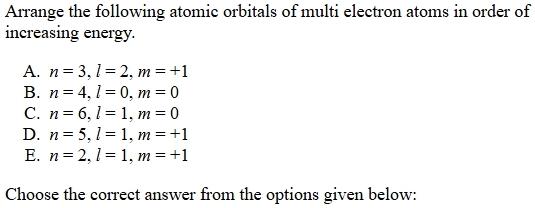
In multi-electron atoms, orbitals fill in order of increasing $(n+l)$. For equal $(n+l)$, the lower $n$ comes first.
E: $2p$, $n+l=3$
B: $4s$, $n+l=4$
A: $3d$, $n+l=5$
D: $5p$, $n+l=6$
C: $6p$, $n+l=7$
Increasing energy: $E<B<A<D<C$
Q6 · MathematicsProbabilityJEE Main 5 April 2026, Shift 1Single correct

Show answer and solution
Correct answer: Option (2): 10/17
Use Bayes' theorem. Each city is equally likely before looking at the envelope.
KANPUR has 5 consecutive pairs: KA, AN, NP, PU, UR. AN appears once, so the chance is $\dfrac15$.
ANANTPUR has 7 consecutive pairs: AN, NA, AN, NT, TP, PU, UR. AN appears twice, so the chance is $\dfrac27$.
$P(\text{ANANTPUR}\mid AN)=\dfrac{\frac12\cdot\frac27}{\frac12\cdot\frac27+\frac12\cdot\frac15}=\dfrac{10/35}{17/35}=\dfrac{10}{17}$
Q7 · PhysicsLaws of MotionJEE Main 5 April 2026, Shift 1Single correct

Show answer and solution
Correct answer: Option (1): 5/3
One side of the pulley carries $m_1=4$ kg and the other carries $m_2+m_3=10$ kg.
Acceleration: $a=\dfrac{(10-4)g}{14}=\dfrac{3g}{7}$, with the 10 kg side moving down.
For $m_1$ moving up: $T_1-4g=4a$, so $T_1=4g+\dfrac{12g}{7}=\dfrac{40g}{7}$
For $m_3$ moving down: $6g-T_2=6a$, so $T_2=6g-\dfrac{18g}{7}=\dfrac{24g}{7}$
$\dfrac{T_1}{T_2}=\dfrac{40}{24}=\dfrac53$
Q8 · ChemistryIonic EquilibriumJEE Main 5 April 2026, Shift 1Single correct

Show answer and solution
Correct answer: Option (1)
Molar solubility $s=\dfrac{x}{y}\ \mathrm{mol\,L^{-1}}$.
$\mathrm{M_3A_2\rightleftharpoons3M^{2+}+2A^{3-}}$
$[\mathrm{A^{3-}}]=2s$ and $K_{sp}=(3s)^3(2s)^2=108s^5$
$\dfrac{[\mathrm{A^{3-}}]}{K_{sp}}=\dfrac{2s}{108s^5}=\dfrac{1}{54s^4}=\dfrac{1}{54}\cdot\dfrac{y^4}{x^4}$
Q9 · MathematicsStatisticsJEE Main 5 April 2026, Shift 1Single correct

Show answer and solution
Correct answer: Option (3): 44/13
$N=8+6+2+2+2+6=26$
$\sum f_ix_i=40+42+18+20+24+90=234$, so the mean is $\dfrac{234}{26}=9$.
$\sum f_i|x_i-9|=8(4)+6(2)+2(0)+2(1)+2(3)+6(6)=88$
Mean deviation $=\dfrac{88}{26}=\dfrac{44}{13}$
Q10 · PhysicsThermodynamicsJEE Main 5 April 2026, Shift 1Single correct
Show answer and solution
Correct answer: Option (3): A, B and D only
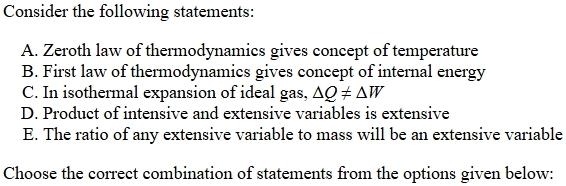
A is true: the zeroth law leads to the concept of temperature.
B is true: the first law introduces internal energy.
C is false: in an isothermal process of an ideal gas $\Delta U=0$, so $\Delta Q=\Delta W$.
D is true: for example, pressure times volume scales with the size of the system.
E is false: an extensive quantity per unit mass is intensive.
The correct statements are A, B and D.
Q11 · ChemistryChemical KineticsJEE Main 5 April 2026, Shift 1Single correct

Show answer and solution
Correct answer: Option (1)
Let $x$ be the pressure of A that has reacted at time $t$.
A: $p_i-x$, B: $x$, C: $x$
$p_t=p_i+x$, so $x=p_t-p_i$
Pressure of A remaining $=p_i-(p_t-p_i)=2p_i-p_t$
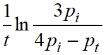
For first order: $k=\dfrac1t\ln\dfrac{p_i}{2p_i-p_t}$
Q12 · MathematicsConic SectionsJEE Main 5 April 2026, Shift 1Single correct

Show answer and solution
Correct answer: Option (3): 24/5
The focus gives $ae=4$. With $e=\dfrac45$, we get $a=5$.
$b^2=a^2(1-e^2)=25\left(1-\dfrac{16}{25}\right)=9$
Since $P(3,\alpha)$ lies on the ellipse:
$\dfrac{9}{25}+\dfrac{\alpha^2}{9}=1\ \Rightarrow\ \alpha^2=\dfrac{144}{25}\ \Rightarrow\ |\alpha|=\dfrac{12}{5}$
Triangle POS has base $OS=4$ on the $x$-axis and height $|\alpha|$.
Area $=\dfrac12\times4\times\dfrac{12}{5}=\dfrac{24}{5}$
Q13 · PhysicsKinematicsJEE Main 5 April 2026, Shift 1Numerical answer

Show answer and solution
Correct answer: 13
After falling from 18 m to height $h$, the speed satisfies $v^2=2g(18-h)$.
We need $v$ to have the same magnitude as $g$, so $v=10$.
$100=2(10)(18-h)$
$18-h=5\ \Rightarrow\ h=13$ m
Q14 · ChemistryChemical BondingJEE Main 5 April 2026, Shift 1Numerical answer

Show answer and solution
Correct answer: 4
Count bond pairs plus lone pairs on the central atom. Five pairs means $sp^3d$.
$\mathrm{SF_4}$: 4 bonds + 1 lone pair = 5
$\mathrm{ClF_3}$: 3 bonds + 2 lone pairs = 5
$\mathrm{XeF_2}$: 2 bonds + 3 lone pairs = 5
$\mathrm{ICl_2^-}$: 2 bonds + 3 lone pairs = 5
The others are different: $\mathrm{BF_4^-}$ and $\mathrm{NH_4^+}$ have 4 pairs; $\mathrm{BrF_5}$, $\mathrm{ICl_4^-}$ and $\mathrm{XeF_4}$ have 6; $\mathrm{XeF_5^-}$ has 7.
Number of $sp^3d$ species $=4$
Q15 · MathematicsPermutations and CombinationsJEE Main 5 April 2026, Shift 1Numerical answer

Show answer and solution
Correct answer: 72
Since $f$ is one-one, $f(2)+f(3)=5$ allows $(f(2),f(3))=(1,4),(4,1),(2,3),(3,2)$. All four satisfy $f(3)\le4$.
Now $f(1)\ge3$ must avoid the two values already used.
For $(1,4)$ and $(4,1)$: $f(1)\in\{3,5,6\}$, which is 3 ways each.
For $(2,3)$ and $(3,2)$: $f(1)\in\{4,5,6\}$, which is 3 ways each.
That is $4\times3=12$ ways for $f(1),f(2),f(3)$.
The remaining 3 values go to $f(4),f(5),f(6)$ in $3!=6$ ways.
Total $=12\times6=72$