JEE Advanced Previous Year Questions – Practice Set 3
Practice Set 3 leans towards chapters that students often leave for revision at the end: capacitors with dielectrics, electromagnetic waves, rotational motion, coordination compounds and metallurgy.
The Mathematics half is algebra and calculus heavy, with circles, differential equations, matrices, sequences and series and vectors. Use this set to find out whether those chapters are actually exam-ready.
How to use this set: set a timer for about 45 minutes, attempt each question before you click “Show answer and solution”, and mark the ones you get wrong. Those chapters are your revision list for this week.
Q1 · PhysicsCapacitanceJEE Advanced 2023 Paper 1Single correct
Show answer and solution
Correct answer: B
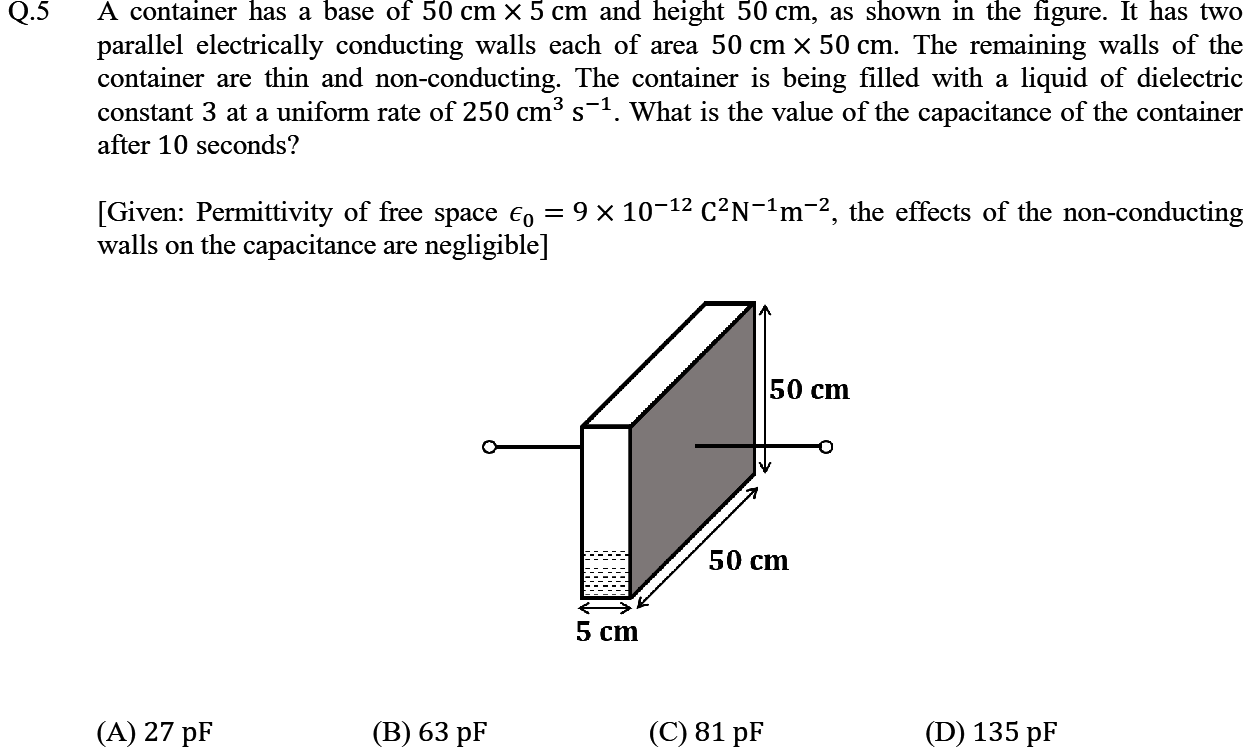
The two conducting plates are vertical, so the filled and unfilled parts act as two capacitors in parallel.
Volume filled in 10 s: $V=250\times10=2500\ \mathrm{cm^3}$
Base area $=50\times5=250\ \mathrm{cm^2}$, so liquid height $h=\dfrac{2500}{250}=10\ \mathrm{cm}$
Given: $d=5\ \mathrm{cm}=0.05\ \mathrm{m}$, plate width $=0.5\ \mathrm{m}$, $K=3$, $\epsilon_0=9\times10^{-12}$ SI
Formula: $C=\dfrac{K\epsilon_0 A}{d}$, and $C_{net}=C_1+C_2$ for parallel combination
Filled part: $A_1=0.5\times0.1=0.05\ \mathrm{m^2}$
$C_1=\dfrac{3\times9\times10^{-12}\times0.05}{0.05}=27\ \mathrm{pF}$
Air part: $A_2=0.5\times0.4=0.2\ \mathrm{m^2}$
$C_2=\dfrac{9\times10^{-12}\times0.2}{0.05}=36\ \mathrm{pF}$
$C_{net}=27+36=63\ \mathrm{pF}$
∴ $C=63\ \mathrm{pF}$
Ans: (B)
Q2 · ChemistryChemical EquilibriumJEE Advanced 2019 Paper 1Numerical answer

Show answer and solution
Correct answer: 8.7 to 9.1
Since K is huge, essentially all Fe²⁺ precipitates as FeS, so the leftover S²⁻ is found first and K then gives the tiny [Fe²⁺].
Mixing equal volumes halves each concentration:
$[\mathrm{Fe^{2+}}]_0 = 0.03\ \mathrm{M}$, $[\mathrm{S^{2-}}]_0 = 0.1\ \mathrm{M}$
Fe²⁺ is the limiting reagent, so it is consumed almost completely:
$[\mathrm{S^{2-}}] = 0.1 - 0.03 = 0.07\ \mathrm{M}$
For the reaction as written, $K_c = \dfrac{1}{[\mathrm{Fe^{2+}}][\mathrm{S^{2-}}]}$ (FeS is a solid).
$[\mathrm{Fe^{2+}}] = \dfrac{1}{K_c\,[\mathrm{S^{2-}}]} = \dfrac{1}{1.6\times10^{17}\times 0.07}$
$= \dfrac{1}{1.12\times10^{16}} = 8.93\times10^{-17}\ \mathrm{M}$
So $Y \approx 8.9$.
The trap is using the original concentrations (0.06 and 0.2) without halving them after mixing. Also, K is the reciprocal of $K_{sp}$ here.
Ans: 8.93
Q3 · MathematicsCirclesJEE Advanced 2022 Paper 1Numerical answer
Show answer and solution
Correct answer: 0.83 to 0.84
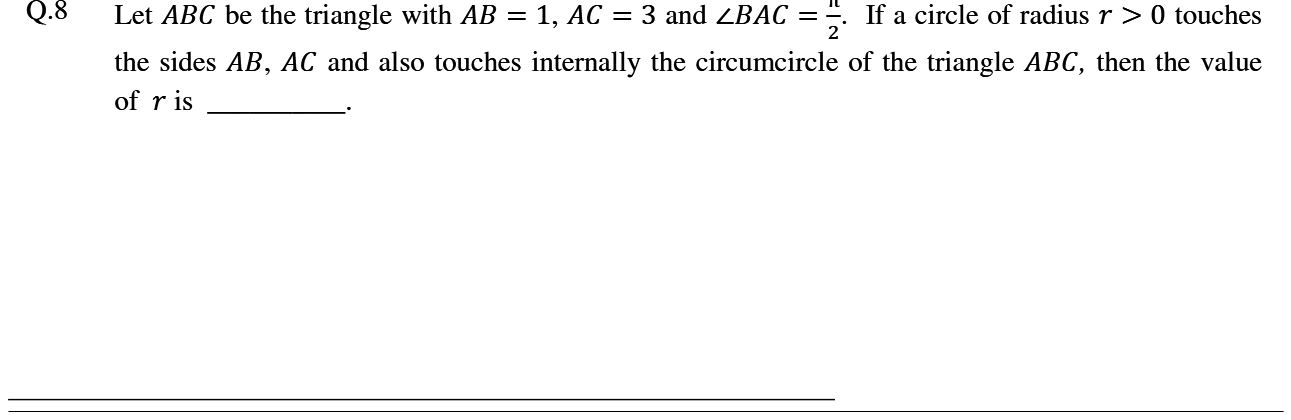
Angle $A=\dfrac{\pi}{2}$, so $BC$ is a diameter of the circumcircle. Put $A$ at the origin, $B(1,0)$, $C(0,3)$.
Circumcircle: centre $\left(\dfrac12,\dfrac32\right)$, radius $R=\dfrac{BC}{2}=\dfrac{\sqrt{10}}{2}$
A circle touching both axes (the lines $AB$, $AC$) inside the angle has centre $(r,r)$ and radius $r$.
Internal contact means the distance between centres is $R-r$.
⇒ $\left(r-\dfrac12\right)^2+\left(r-\dfrac32\right)^2=\left(\dfrac{\sqrt{10}}{2}-r\right)^2$
⇒ $2r^2-4r+\dfrac52=\dfrac52-\sqrt{10}\,r+r^2$
⇒ $r^2-(4-\sqrt{10})\,r=0$
Since $r>0$, $r=4-\sqrt{10}\approx 0.838$
∴ $r=4-\sqrt{10}\approx 0.84$
Ans: 0.84
Q4 · PhysicsElectromagnetic WavesJEE Advanced 2023 Paper 2One or more correct

Show answer and solution
Correct answer: A, D
Use $B_0=E_0/v$ with $\vec B \parallel \hat k\times\vec E$, where the wave travels along $+z$.
Given: $f=5\times10^{14}\ \mathrm{Hz}$, $\dfrac{1}{\lambda}=\dfrac{10^7}{3}\ \mathrm{m^{-1}}$, $c=3\times10^8\ \mathrm{m\,s^{-1}}$
Speed in the medium: $v=f\lambda=5\times10^{14}\times\dfrac{3}{10^7}=1.5\times10^8\ \mathrm{m\,s^{-1}}$
(D) $n=\dfrac{c}{v}=\dfrac{3\times10^8}{1.5\times10^8}=2$ ⇒ correct
Direction of $\vec B$: $\hat z\times(2\hat x+\hat y)=2\hat y-\hat x$
Magnitude factor: $\dfrac{30}{v}=\dfrac{30}{1.5\times10^8}=2\times10^{-7}$
So $\vec B=2\times10^{-7}(-\hat x+2\hat y)\sin[\ldots]$
(A) $B_x=-2\times10^{-7}\sin[\ldots]$ ⇒ correct
(B) $B_y=+4\times10^{-7}$, not $2\times10^{-7}$ ⇒ incorrect. This is the common trap: forgetting the factor 2 in $\hat y$.
(C) $\tan\theta=\dfrac{E_y}{E_x}=\dfrac{1}{2}$, so $\theta\approx26.6^\circ\neq30^\circ$ ⇒ incorrect
Ans: (A), (D)
Q5 · ChemistryCoordination CompoundsJEE Advanced 2021 Paper 2Single correct
Show answer and solution
Correct answer: C
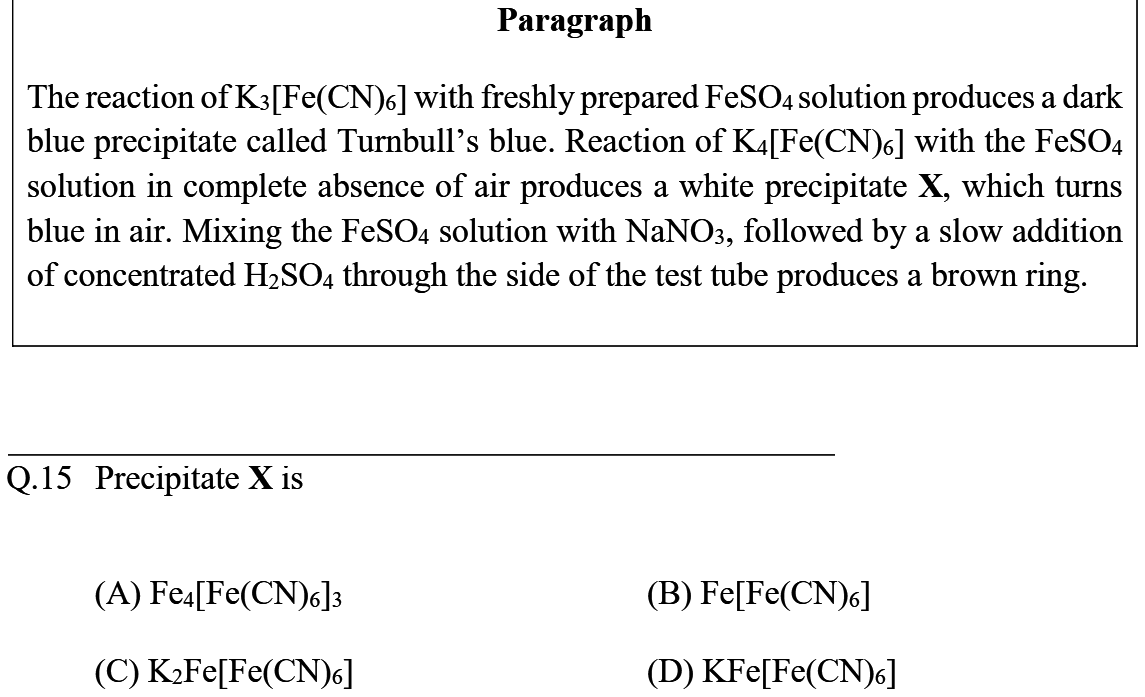
The white precipitate X forms when $\mathrm{K_4[Fe(CN)_6]}$ reacts with $\mathrm{FeSO_4}$ in the absence of air. It turns blue on oxidation, so it must be the Fe(II)–Fe(II) cyanide complex with potassium.
$\mathrm{2K_4[Fe(CN)_6] + 2FeSO_4 \rightarrow 2K_2Fe[Fe(CN)_6] + 2K_2SO_4}$
Check charge: $\mathrm{[Fe(CN)_6]^{4-}}$ is balanced by $\mathrm{Fe^{2+}}$ and $\mathrm{2K^+}$, so $\mathrm{K_2Fe[Fe(CN)_6]}$ is neutral.
Trap: (B) $\mathrm{Fe[Fe(CN)_6]}$ would need $\mathrm{Fe^{2+}}$ to balance a 4− ion, but that gives only 2+. So it is not neutral and cannot be the answer.
Air oxidation of X:
$\mathrm{K_2Fe^{II}[Fe^{II}(CN)_6] \xrightarrow{O_2,\ air} KFe^{III}[Fe^{II}(CN)_6]}$ (soluble Prussian blue, blue)
(A) $\mathrm{Fe_4[Fe(CN)_6]_3}$ is Prussian blue, the Fe(III) product from $\mathrm{FeCl_3}$ with $\mathrm{K_4[Fe(CN)_6]}$. It is not white.
(D) $\mathrm{KFe[Fe(CN)_6]}$ has Fe(III), so it is blue, not white.
∴ X = $\mathrm{K_2Fe[Fe(CN)_6]}$ (potassium iron(II) hexacyanoferrate(II), white).
Ans: (C)
Q6 · MathematicsDifferential EquationsJEE Advanced 2023 Paper 2Integer answer

Show answer and solution
Correct answer: 16
Dividing by $(x^2-5)^2$ turns the left side into an exact derivative of $\dfrac{y}{x^2-5}$.
$(x^2-5)\dfrac{dy}{dx}-2xy=-2x(x^2-5)^2$
⇒ $\dfrac{(x^2-5)y'-2xy}{(x^2-5)^2}=-2x$
⇒ $\dfrac{d}{dx}\left(\dfrac{y}{x^2-5}\right)=-2x$
Integrate: $\dfrac{y}{x^2-5}=-x^2+C$
Use $y(2)=7$: $\dfrac{7}{-1}=-4+C$ ⇒ $C=-3$
⇒ $y=-(x^2-5)(x^2+3)=-(x^4-2x^2-15)$
Let $t=x^2\ge 0$, so $y=-(t^2-2t-15)=16-(t-1)^2$
Maximum occurs at $t=1$, i.e. $x=\pm1$, which is allowed.
∴ $y_{max}=16$
Ans: 16
Q7 · PhysicsKinematicsJEE Advanced 2023 Paper 1Integer answer

Show answer and solution
Correct answer: 40
Similar triangles give the position of the shadow tip, and differentiating gives its speed relative to the person.
Take the lamp post as origin, +x along the path. Person at $x$, shadow tip at $s$.
Given: $H=4\ \mathrm{m}$, $h=1.6\ \mathrm{m}$, $v_p=60\ \mathrm{cm\,s^{-1}}$
Similar triangles: $\dfrac{H}{s}=\dfrac{h}{s-x}$
$4(s-x)=1.6\,s$
$2.4\,s=4x$
$s=\dfrac{5}{3}x$
Differentiate w.r.t. time: $v_s=\dfrac{5}{3}v_p=\dfrac{5}{3}\times60=100\ \mathrm{cm\,s^{-1}}$
The trap here is that 100 cm/s is the speed w.r.t. the ground. The question asks w.r.t. the person.
$v_{s/p}=v_s-v_p=100-60=40\ \mathrm{cm\,s^{-1}}$
∴ Speed of shadow tip w.r.t. person $=40\ \mathrm{cm\,s^{-1}}$
Ans: 40
Q8 · ChemistryMetallurgyJEE Advanced 2019 Paper 2One or more correct

Show answer and solution
Correct answer: A, B, C
Gold dissolves in cyanide only when air (O₂) oxidises it, so first fix Q and R.
$\mathrm{4Au + 8CN^- + 2H_2O + O_2 \rightarrow 4[Au(CN)_2]^- + 4OH^-}$
Q = $\mathrm{O_2}$, R = $\mathrm{[Au(CN)_2]^-}$ (Au is +1, coordination number 2)
Now R is reduced by a more electropositive metal. Zn displaces Au:
$\mathrm{2[Au(CN)_2]^- + Zn \rightarrow 2Au + [Zn(CN)_4]^{2-}}$
T = Zn, Z = $\mathrm{[Zn(CN)_4]^{2-}}$
(A) Q is $\mathrm{O_2}$ ⇒ correct
(B) T is Zn ⇒ correct
(C) Z is $\mathrm{[Zn(CN)_4]^{2-}}$ ⇒ correct
(D) The trap: R is $\mathrm{[Au(CN)_2]^-}$, not $\mathrm{[Au(CN)_4]^-}$ ⇒ incorrect
Ans: (A), (B), (C)
Q9 · MathematicsMatricesJEE Advanced 2020 Paper 2Integer answer

Show answer and solution
Correct answer: 5
Use the eigenvalues $\lambda_1,\lambda_2$ of $A$, since the trace of $A^3$ is $\lambda_1^3+\lambda_2^3$.
Given: $\lambda_1+\lambda_2=3$, $\lambda_1^3+\lambda_2^3=-18$
Use $a^3+b^3=(a+b)^3-3ab(a+b)$ with $\lambda_1\lambda_2=\det A=d$
⇒ $-18=27-3d(3)$
⇒ $-18=27-9d$
⇒ $9d=45$
∴ $\det A=5$
Check: the characteristic equation $\lambda^2-3\lambda+5=0$ has complex roots, which is fine for a real matrix. The sum of the cubes is still real.
Ans: 5
Q10 · PhysicsMechanical Properties of SolidsJEE Advanced 2020 Paper 2Numerical answer
Show answer and solution
Correct answer: 0.23 to 0.25
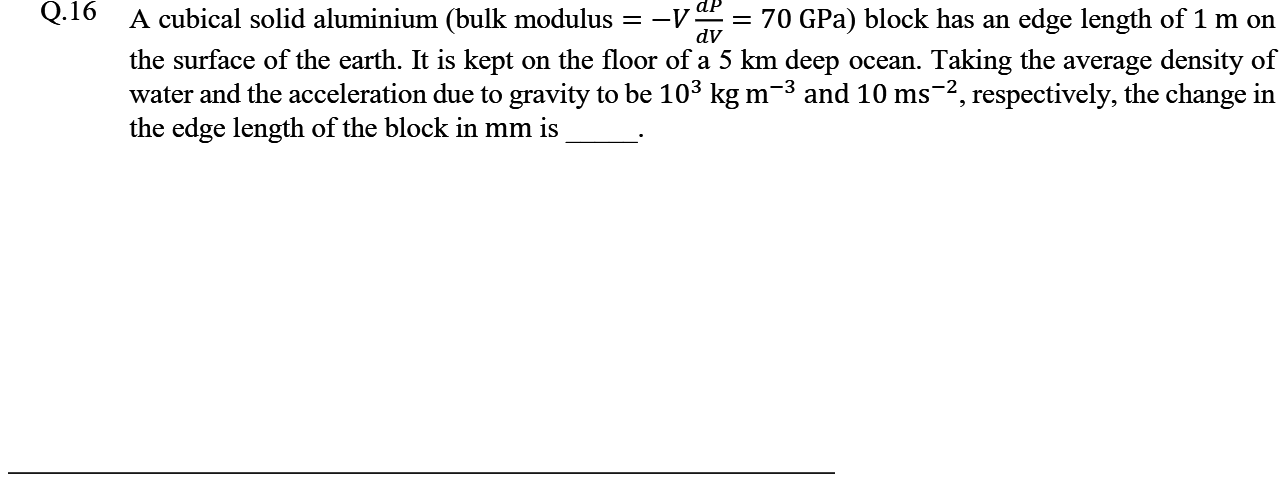
Pressure at the ocean floor is uniform on all faces, so the volume strain is hydrostatic, and the edge strain is one-third of the volume strain.
Given: $B=70\ \mathrm{GPa}=7\times10^{10}\ \mathrm{Pa}$, $L=1\ \mathrm{m}$, $h=5000\ \mathrm{m}$, $\rho=10^3\ \mathrm{kg\,m^{-3}}$, $g=10\ \mathrm{m\,s^{-2}}$
Formula: $B=\dfrac{\Delta P}{-\Delta V/V}$
Pressure increase (the block was at atmospheric pressure at the surface, so only the water column counts):
$\Delta P=\rho g h=10^3\times10\times5000=5\times10^{7}\ \mathrm{Pa}$
Volume strain:
$\dfrac{\Delta V}{V}=\dfrac{\Delta P}{B}=\dfrac{5\times10^{7}}{7\times10^{10}}=\dfrac{1}{1400}$
Since $V=L^3$, $\dfrac{\Delta V}{V}=3\dfrac{\Delta L}{L}$
$\dfrac{\Delta L}{L}=\dfrac{1}{3\times1400}=\dfrac{1}{4200}$
$\Delta L=\dfrac{1}{4200}\ \mathrm{m}=2.38\times10^{-4}\ \mathrm{m}=0.238\ \mathrm{mm}$
∴ Edge length decreases by about $0.24\ \mathrm{mm}$
Ans: 0.24
Q11 · ChemistryRedox ReactionsJEE Advanced 2021 Paper 2Integer answer

Show answer and solution
Correct answer: 6
ClO₂ is oxidised by O₃ to the dimeric oxide Cl₂O₆.
$\mathrm{2ClO_2 + 2O_3 \rightarrow Cl_2O_6 + 2O_2}$
Check the balance: left O = 4 + 6 = 10, right O = 6 + 4 = 10, so the equation is balanced.
Now find the average oxidation state of Cl in $\mathrm{Cl_2O_6}$:
$2x + 6(-2) = 0$
$2x = 12$
$x = +6$
The trap is that $\mathrm{Cl_2O_6}$ is actually ionic in the solid, $\mathrm{[ClO_2]^+[ClO_4]^-}$. Cl is +5 in $\mathrm{ClO_2^+}$ and +7 in $\mathrm{ClO_4^-}$, so the average is $\dfrac{5+7}{2} = +6$.
Ans: 6
Q12 · MathematicsSequences and SeriesJEE Advanced 2023 Paper 1Integer answer
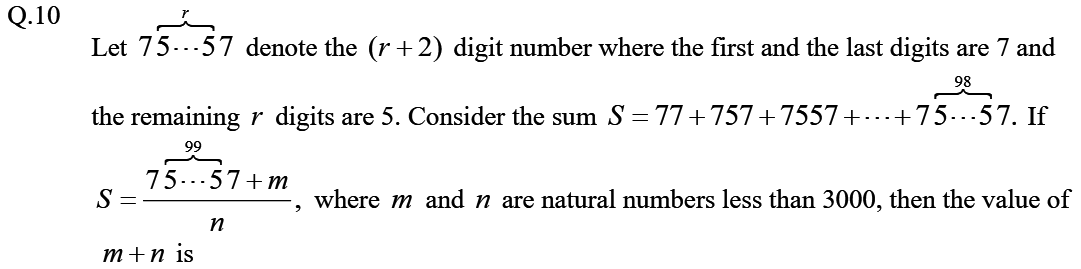
Show answer and solution
Correct answer: 1219
Write each term in closed form as a geometric series, sum it, and compare with the 100-digit number.
The $r$-fives term is $T_r=7\cdot10^{r+1}+10\cdot\dfrac{5(10^r-1)}{9}+7$
⇒ $T_r=\dfrac{680\cdot10^{r}+13}{9}$
Check: $r=0$ gives $\dfrac{693}{9}=77$ ✓, $r=1$ gives $\dfrac{6813}{9}=757$ ✓
$77$ is $r=0$ and the last term has 98 fives, so $r$ runs from $0$ to $98$ (99 terms).
$S=\dfrac19\left[680\cdot\dfrac{10^{99}-1}{9}+13\cdot 99\right]$
⇒ $S=\dfrac{680\cdot10^{99}+10903}{81}$
The number with 99 fives is $r=99$: $N=\dfrac{680\cdot10^{99}+13}{9}$
So $680\cdot10^{99}+10903=9N-13+10903=9N+10890$
⇒ $S=\dfrac{9N+10890}{81}=\dfrac{N+1210}{9}$
Comparing with $S=\dfrac{N+m}{n}$ gives $m=1210,\ n=9$, both less than 3000.
∴ $m+n=1219$
Ans: 1219
Q13 · PhysicsRotational MotionJEE Advanced 2023 Paper 2Integer answer

Show answer and solution
Correct answer: 30
Linear impulse fixes the toss speed, and angular impulse about the diameter fixes the spin rate.
Given: $m=5\times10^{-3}\ \mathrm{kg}$, $R=\dfrac{4}{3}\times10^{-2}\ \mathrm{m}$, $d=\dfrac{2}{3}\times10^{-2}\ \mathrm{m}$, $J=\sqrt{\dfrac{\pi}{2}}\times10^{-2}\ \mathrm{N\,s}$
Translation: $J=mv$
$v=\dfrac{\sqrt{\pi/2}\times10^{-2}}{5\times10^{-3}}=2\sqrt{\dfrac{\pi}{2}}=\sqrt{2\pi}\ \mathrm{m\,s^{-1}}$
Time to return to the starting height:
$T=\dfrac{2v}{g}=\dfrac{2\sqrt{2\pi}}{10}=\dfrac{\sqrt{2\pi}}{5}\ \mathrm{s}$
Rotation: angular impulse about the diameter, $Jd=I\omega$
$I=\dfrac{1}{4}mR^2=\dfrac{1}{4}(5\times10^{-3})\dfrac{16}{9}\times10^{-4}=\dfrac{20}{9}\times10^{-7}\ \mathrm{kg\,m^2}$
$\omega=\dfrac{\sqrt{\pi/2}\times10^{-2}\times\frac{2}{3}\times10^{-2}}{\frac{20}{9}\times10^{-7}}=300\sqrt{\dfrac{\pi}{2}}\ \mathrm{rad\,s^{-1}}$
Notice that no torque acts during flight (gravity acts at the centre), so $\omega$ stays constant.
$\theta=\omega T=300\sqrt{\dfrac{\pi}{2}}\times\dfrac{\sqrt{2\pi}}{5}=60\pi\ \mathrm{rad}$
$n=\dfrac{\theta}{2\pi}=\dfrac{60\pi}{2\pi}=30$
∴ $n=30$
Ans: 30
Q14 · ChemistrySome Basic Concepts of ChemistryJEE Advanced 2020 Paper 1Numerical answer

Show answer and solution
Correct answer: 6 to 6.2
The trap here is that both quantities are given, so first find the limiting reagent.
Balanced rxn: $\mathrm{2Al + 3H_2SO_4 \rightarrow Al_2(SO_4)_3 + 3H_2}$
Given: $w_{Al} = 5.4\ \mathrm{g}$, $M = 27.0\ \mathrm{g\,mol^{-1}}$, $V = 50.0\ \mathrm{mL}$, $M_{acid} = 5.0\ \mathrm{M}$, $T = 300\ \mathrm{K}$, $P = 1.0\ \mathrm{atm}$
$n_{Al} = \dfrac{5.4}{27.0} = 0.2\ \mathrm{mol}$
$n_{H_2SO_4} = 5.0 \times 0.050 = 0.25\ \mathrm{mol}$
Al needs $\dfrac{3}{2} \times 0.2 = 0.3\ \mathrm{mol}$ acid, but only 0.25 mol is available.
∴ $\mathrm{H_2SO_4}$ is the limiting reagent.
$n_{H_2} = n_{H_2SO_4} = 0.25\ \mathrm{mol}$ (3 : 3 ratio)
Formula: $V = \dfrac{nRT}{P}$
$V = \dfrac{0.25 \times 0.082 \times 300}{1.0} = 6.15\ \mathrm{L}$
Ans: 6.15 L
Q15 · MathematicsVectorsJEE Advanced 2018 Paper 1Integer answer

Show answer and solution
Correct answer: 3
The vectors $\vec a,\vec b,\vec a\times\vec b$ are mutually perpendicular unit vectors, so dot products with $\vec c$ pick out the components directly.
$\vec c\cdot\vec a=x$ and $\vec c\cdot\vec b=y$
Equal angles with $\vec a$ and $\vec b$, with $|\vec a|=|\vec b|=1$:
⇒ $|\vec c|\cos\alpha=x$ and $|\vec c|\cos\alpha=y$
⇒ $x=y=2\cos\alpha$
Magnitude: $|\vec c|^2=x^2+y^2+|\vec a\times\vec b|^2=4$
⇒ $x^2+y^2+1=4$
⇒ $2x^2=3$
⇒ $x^2=\dfrac{3}{2}$
Now $x^2=4\cos^2\alpha$
⇒ $\cos^2\alpha=\dfrac{3}{8}$
∴ $8\cos^2\alpha=3$
Ans: 3