JEE Main 2026 – 2 April, Shift 1: Practice Set 1
This set has 15 questions taken from the official NTA JEE Main paper held on 2 April 2026, Shift 1: five each from Physics, Chemistry and Mathematics, with solutions written by the 60MinutesToJEE faculty.
There are 12 single-correct MCQs and 3 numerical-value questions, the same mix as the real paper. Topics include dimensional analysis, electrostatics, electrochemistry, hydrocarbons, complex numbers and sequences and series, which appears twice in this set.
How to use this set: set a timer for about 30 minutes, attempt each question before you click “Show answer and solution”, and mark the ones you get wrong. Those chapters are your revision list for this week.
Q1 · PhysicsUnits and DimensionsJEE Main 2 April 2026, Shift 1Single correct

Show answer and solution
Correct answer: Option (2): 1
$\frac12\epsilon_0E^2$ is the energy stored per unit volume of an electric field, so its dimensions are those of energy divided by volume.
$[\text{Energy}]=ML^2T^{-2}$ and $[\text{Volume}]=L^3$
$\Rightarrow\ \left[\frac12\epsilon_0E^2\right]=ML^{-1}T^{-2}$
So $a=1,\ b=-1,\ c=-2$.
$2a-b+c=2+1-2=1$
Q2 · ChemistrySome Basic ConceptsJEE Main 2 April 2026, Shift 1Single correct

Show answer and solution
Correct answer: Option (4): 42 g
Balanced reaction: $\mathrm{3Fe+4H_2O\rightarrow Fe_3O_4+4H_2}$
Moles of steam $=\dfrac{18}{18}=1$ mol.
4 mol of steam reacts with 3 mol of Fe, so 1 mol of steam reacts with $\dfrac34$ mol of Fe.
Mass of Fe $=\dfrac34\times56=42$ g
Q3 · MathematicsComplex NumbersJEE Main 2 April 2026, Shift 1Single correct

Show answer and solution
Correct answer: Option (4): 75
Rationalise each fraction, then compare real and imaginary parts.
$\dfrac{2x}{1+3i}=\dfrac{2x(1-3i)}{10}=\dfrac{x(1-3i)}{5}$ and $\dfrac{y}{1-2i}=\dfrac{y(1+2i)}{5}$
Left side $=10x(1-3i)-10y(1+2i)=10(x-y)-10(3x+2y)\,i$
Comparing with $31+17i$:
$10(x-y)=31$ and $-10(3x+2y)=17$
So $x-y=3.1$ and $3x+2y=-1.7$. Solving gives $x=0.9,\ y=-2.2$.
$10(x-3y)=10(0.9+6.6)=75$
Q4 · PhysicsGravitationJEE Main 2 April 2026, Shift 1Single correct

Show answer and solution
Correct answer: Option (2): 2
For a planet in a circular orbit, $T=2\pi\sqrt{\dfrac{r^3}{GM}}$, so $T\propto\sqrt{\dfrac{r^3}{M}}$.
For $P_1$: $T_1\propto\sqrt{\dfrac{R^3}{2M}}$
For $P_2$: $T_2\propto\sqrt{\dfrac{(2R)^3}{4M}}=\sqrt{\dfrac{2R^3}{M}}$
$\dfrac{T_2}{T_1}=\sqrt{\dfrac{2}{1/2}}=\sqrt4=2$
Q5 · ChemistryAtomic StructureJEE Main 2 April 2026, Shift 1Single correct

Show answer and solution
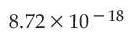
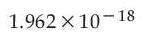
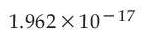
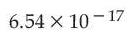
Correct answer: Option (3): $1.962\times10^{-17}$
$\mathrm{Li^{2+}}$ has one electron, so it is hydrogen-like with $Z=3$. Ionisation energy from the ground state scales as $Z^2$.
$E=Z^2\times E_H=9\times2.18\times10^{-18}$
$E=1.962\times10^{-17}\ \mathrm{J\,atom^{-1}}$
Q6 · MathematicsLinear EquationsJEE Main 2 April 2026, Shift 1Single correct
Show answer and solution
Correct answer: Option (2): 4
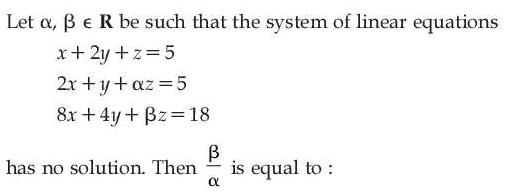
The left side of the third equation has $8x+4y=4(2x+y)$, so compare it with 4 times the second equation.
$4\times$ second equation: $8x+4y+4\alpha z=20$
Third equation: $8x+4y+\beta z=18$
Subtracting: $(\beta-4\alpha)z=-2$
If $\beta\neq4\alpha$, this gives a value of $z$ and the system can be solved. For no solution we need the left side to vanish while the right side stays $-2$.
So $\beta=4\alpha$, which gives $\dfrac{\beta}{\alpha}=4$.
Q7 · PhysicsElectrostaticsJEE Main 2 April 2026, Shift 1Single correct

Show answer and solution
Correct answer: Option (4): 9/4
Connected conducting spheres reach the same potential $V$.
At the surface of a sphere, $E=\dfrac{V}{R}$.
$\dfrac{E_{S_1}}{E_{S_2}}=\dfrac{R_2}{R_1}=\dfrac{18}{8}=\dfrac94$
Q8 · ChemistryThermodynamicsJEE Main 2 April 2026, Shift 1Single correct
Show answer and solution
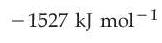
Correct answer: Option (4): $-1527$ kJ/mol
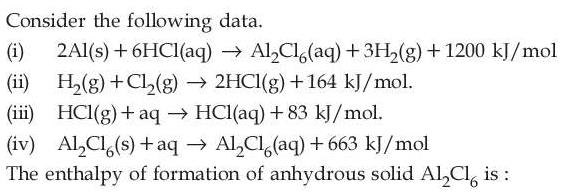
The heat written on the product side is released, so write each step with a negative $\Delta H$.
Target: $\mathrm{2Al(s)+3Cl_2(g)\rightarrow Al_2Cl_6(s)}$
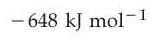
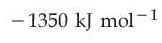
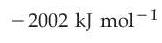
Combine the data as (i) $+\ 3\times$(ii) $+\ 6\times$(iii) $-$ (iv). The $\mathrm{HCl}$, $\mathrm{H_2}$ and $\mathrm{Al_2Cl_6(aq)}$ terms then cancel.
$\Delta H=-1200+3(-164)+6(-83)-(-663)$
$\Delta H=-1200-492-498+663=-1527\ \mathrm{kJ\,mol^{-1}}$
Q9 · MathematicsSequences and SeriesJEE Main 2 April 2026, Shift 1Single correct

Show answer and solution
Correct answer: Option (2): 5
A has terms $1,6,11,\ldots,501$ and B has terms $9,16,23,\ldots,499$.
Common terms satisfy $x\equiv1\pmod5$ and $x\equiv2\pmod7$. The smallest such term in B is $16$, and the common terms repeat every $\mathrm{lcm}(5,7)=35$.
Common terms: $x=16+35k$, with $x\le499$, so $k=0,1,\ldots,13$.
Divisible by 3: $16+35k\equiv1+2k\pmod3$, which is $0$ when $k\equiv1\pmod3$.
So $k=1,4,7,10,13$, giving $5$ elements.
Q10 · PhysicsThermodynamicsJEE Main 2 April 2026, Shift 1Single correct

Show answer and solution
Correct answer: Option (4): 7 : 5 : 2
For $n$ moles of a diatomic gas at constant pressure:
$\Delta Q=nC_p\Delta T=\dfrac72nR\Delta T$
$\Delta U=nC_v\Delta T=\dfrac52nR\Delta T$
$\Delta W=P\Delta V=nR\Delta T$
$\Delta Q:\Delta U:\Delta W=\dfrac72:\dfrac52:1=7:5:2$
Q11 · ChemistryElectrochemistryJEE Main 2 April 2026, Shift 1Single correct

Show answer and solution
Correct answer: Option (1)
In a spontaneous cell the half-cell with the higher reduction potential is reduced.
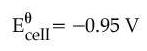
$\mathrm{AgBr}$ ($+0.07$ V) is reduced at the cathode, and Fe is oxidised at the anode, where $\mathrm{Fe(OH)_2/Fe}$ has $E^\circ=-0.88$ V.
$E^\circ_{cell}=0.07-(-0.88)=+0.95$ V
Overall: $\mathrm{Fe(s)+2OH^-(aq)+2AgBr(s)\rightleftharpoons Fe(OH)_2(s)+2Ag(s)+2Br^-(aq)}$
This is option (1). Option (2) has the wrong sign, Fe is oxidised rather than reduced, and $E^\circ_{cell}$ is an intensive property.
Q12 · MathematicsPermutations and CombinationsJEE Main 2 April 2026, Shift 1Single correct

Show answer and solution
Correct answer: Option (3): 16800
Seven places hold five different digits, each used at least once. The two extra places give two possible patterns.
Pattern 3, 1, 1, 1, 1: choose the repeated digit in 5 ways.
$5\times\dfrac{7!}{3!}=5\times840=4200$
Pattern 2, 2, 1, 1, 1: choose the two repeated digits in $^5C_2=10$ ways.
$10\times\dfrac{7!}{2!\,2!}=10\times1260=12600$
Total $=4200+12600=16800$
Q13 · PhysicsMoving Charges and MagnetismJEE Main 2 April 2026, Shift 1Numerical answer
Show answer and solution
Correct answer: 171
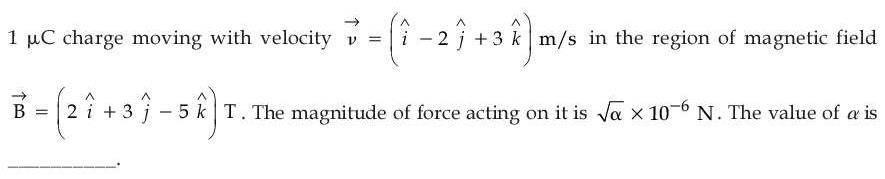
Use $\vec F=q(\vec v\times\vec B)$ with $\vec v=(1,-2,3)$ and $\vec B=(2,3,-5)$.
$x$-component: $(-2)(-5)-(3)(3)=1$
$y$-component: $(3)(2)-(1)(-5)=11$
$z$-component: $(1)(3)-(-2)(2)=7$
$|\vec v\times\vec B|=\sqrt{1+121+49}=\sqrt{171}$
With $q=10^{-6}$ C, $F=\sqrt{171}\times10^{-6}$ N, so $\alpha=171$.
Q14 · ChemistryHydrocarbonsJEE Main 2 April 2026, Shift 1Numerical answer

Show answer and solution
Correct answer: 17
Combustion of an alkane: $\mathrm{C_nH_{2n+2}+\dfrac{3n+1}{2}O_2\rightarrow nCO_2+(n+1)H_2O}$
$\dfrac{3n+1}{2}=8\ \Rightarrow\ n=5$
The alkane is $\mathrm{C_5H_{12}}$, so the number of C and H atoms is $5+12=17$.
Q15 · MathematicsSequences and SeriesJEE Main 2 April 2026, Shift 1Numerical answer

Show answer and solution
Correct answer: 91
The $k$th term is the difference of consecutive sums.
$a_k=6k^3-6(k-1)^3=6(3k^2-3k+1)$
$a_{k+1}-a_k=6\left[3(2k+1)-3\right]=36k$
So $\dfrac{a_{k+1}-a_k}{36}=k$.
$\displaystyle\sum_{k=1}^{6}k^2=\dfrac{6\cdot7\cdot13}{6}=91$