JEE Advanced Previous Year Questions – Practice Set 1
Practice Set 1 is a good starting point for JEE Advanced preparation. It has 15 real JEE Advanced questions from the 2020 to 2026 papers, five each from Physics, Chemistry and Mathematics, picked so that no chapter repeats.
Most questions in this set are integer-type, where there are no options to guess from, so they test whether you can carry a calculation through cleanly. You will find an AC circuit with a lamp and capacitor, a hydrogen-like atom transition, a 3D geometry multiple-correct problem and a 2026 Paper 2 statistics question.
How to use this set: set a timer for about 45 minutes, attempt each question before you click “Show answer and solution”, and mark the ones you get wrong. Those chapters are your revision list for this week.
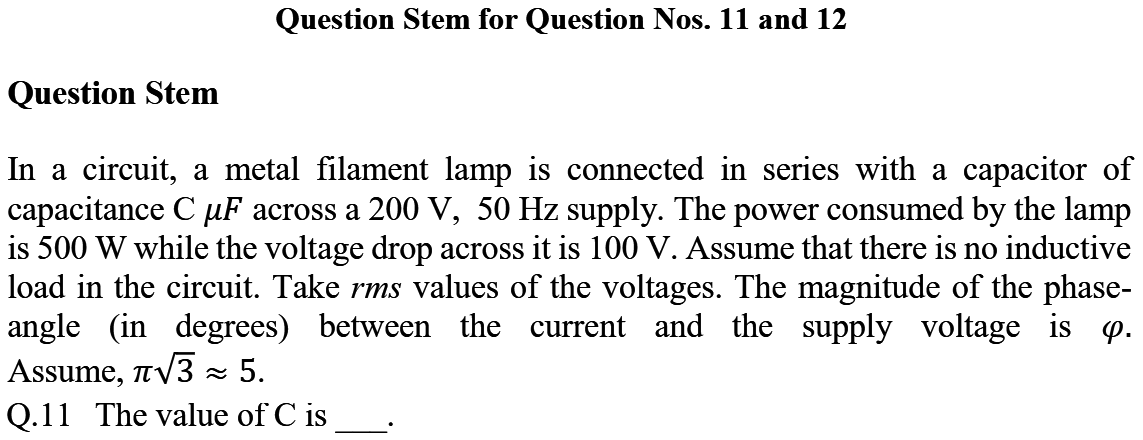
Q1 · PhysicsAlternating CurrentJEE Advanced 2021 Paper 2Integer answer
Show answer and solution
Correct answer: 100
Since the lamp and capacitor are in series, the same current flows through both, so find the current from the lamp's power and voltage.
Given: $V=200\ \mathrm{V}$, $f=50\ \mathrm{Hz}$, $P=500\ \mathrm{W}$, $V_R=100\ \mathrm{V}$
Lamp is purely resistive: $P=V_R I$
$I=\dfrac{500}{100}=5\ \mathrm{A}$
Series circuit (no inductor): $V^2=V_R^2+V_C^2$
$V_C=\sqrt{200^2-100^2}=100\sqrt3\ \mathrm{V}$
$X_C=\dfrac{V_C}{I}=\dfrac{100\sqrt3}{5}=20\sqrt3\ \Omega$
Use $X_C=\dfrac{1}{2\pi f C}$
$C=\dfrac{1}{2\pi f X_C}=\dfrac{1}{2\pi\times50\times20\sqrt3}=\dfrac{1}{2000\,\pi\sqrt3}$
Given $\pi\sqrt3\approx5$ ⇒ $C=\dfrac{1}{2000\times5}=10^{-4}\ \mathrm{F}$
$C=100\ \mu\mathrm{F}$
∴ $C=100\ \mu\mathrm{F}$
Ans: 100
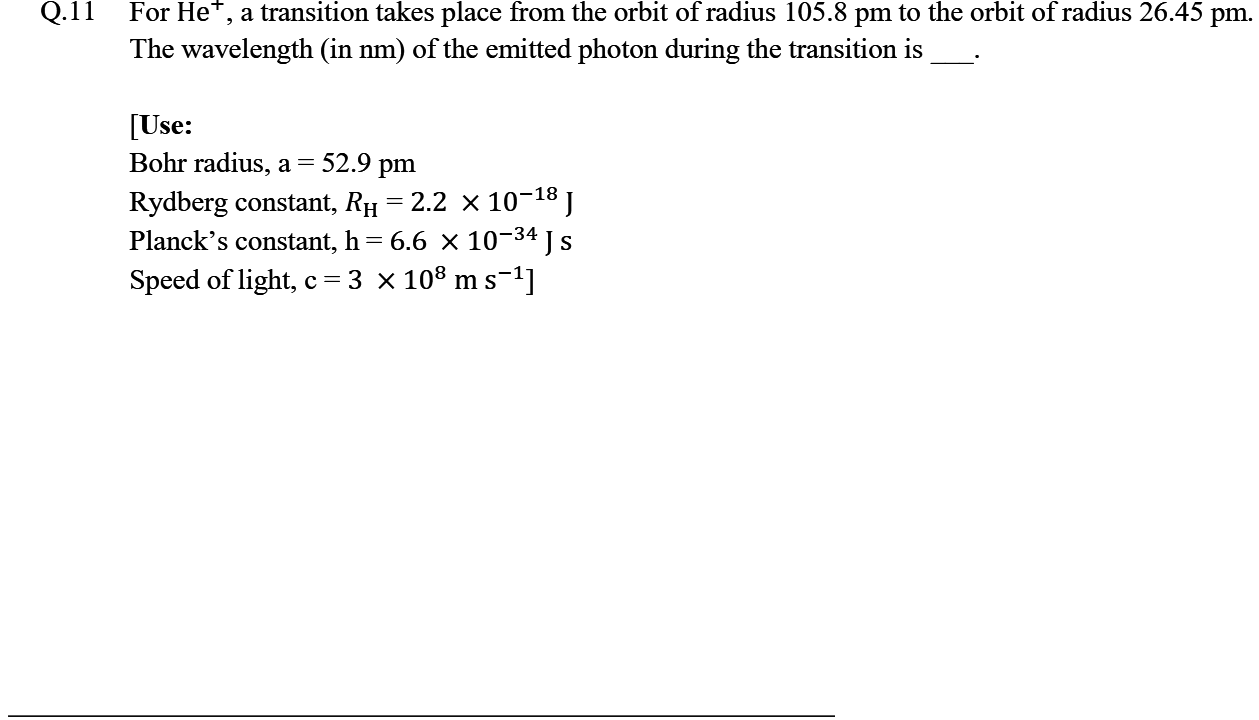
Q2 · ChemistryAtomic StructureJEE Advanced 2023 Paper 2Integer answer
Show answer and solution
Correct answer: 30
The radius formula $r_n = \dfrac{a\,n^2}{Z}$ gives n for each orbit, and then $\Delta E = R_H Z^2\left(\dfrac{1}{n_1^2}-\dfrac{1}{n_2^2}\right)$ gives the photon energy.
Given: $Z = 2$, $a = 52.9\ \mathrm{pm}$, $R_H = 2.2\times10^{-18}\ \mathrm{J}$, $h = 6.6\times10^{-34}\ \mathrm{J\,s}$, $c = 3\times10^8\ \mathrm{m\,s^{-1}}$
First find n from each radius.
$n^2 = \dfrac{rZ}{a} = \dfrac{105.8\times 2}{52.9} = 4 \Rightarrow n = 2$
$n^2 = \dfrac{26.45\times 2}{52.9} = 1 \Rightarrow n = 1$
So the transition is $n=2 \rightarrow n=1$.
$\Delta E = 2.2\times10^{-18}\times 4\times\left(1-\dfrac14\right)$
$\Delta E = 6.6\times10^{-18}\ \mathrm{J}$
$\lambda = \dfrac{hc}{\Delta E} = \dfrac{6.6\times10^{-34}\times 3\times10^{8}}{6.6\times10^{-18}}$
$\lambda = 3\times10^{-8}\ \mathrm{m} = 30\ \mathrm{nm}$
Ans: 30
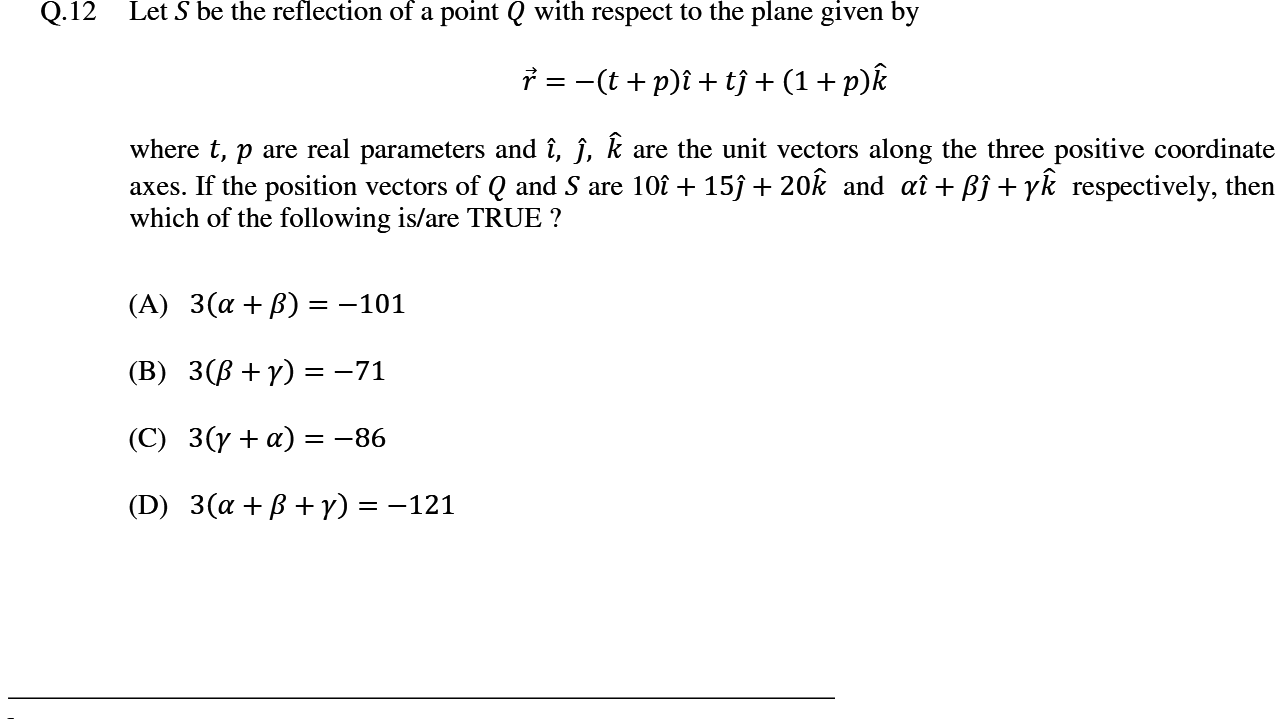
Q3 · Mathematics3D GeometryJEE Advanced 2022 Paper 1One or more correct
Show answer and solution
Correct answer: A, B, C
Eliminate $t$ and $p$ to get the Cartesian equation of the plane, then use the reflection formula.
Given: $x=-(t+p)$, $y=t$, $z=1+p$
⇒ $x+y=-p$ and $z-1=p$
⇒ $x+y+z=1$
Notice that the plane has normal $(1,1,1)$.
For $Q(10,15,20)$: $10+15+20-1=44$
Reflection: $S=Q-\dfrac{2(ax_1+by_1+cz_1-d)}{a^2+b^2+c^2}(a,b,c)$
⇒ $S=(10,15,20)-\dfrac{88}{3}(1,1,1)$
$\alpha=-\dfrac{58}{3}$, $\beta=-\dfrac{43}{3}$, $\gamma=-\dfrac{28}{3}$
(A) $3(\alpha+\beta)=-58-43=-101$ ⇒ true
(B) $3(\beta+\gamma)=-43-28=-71$ ⇒ true
(C) $3(\gamma+\alpha)=-28-58=-86$ ⇒ true
(D) $3(\alpha+\beta+\gamma)=-129\neq-121$ ⇒ false
Ans: (A), (B), (C)
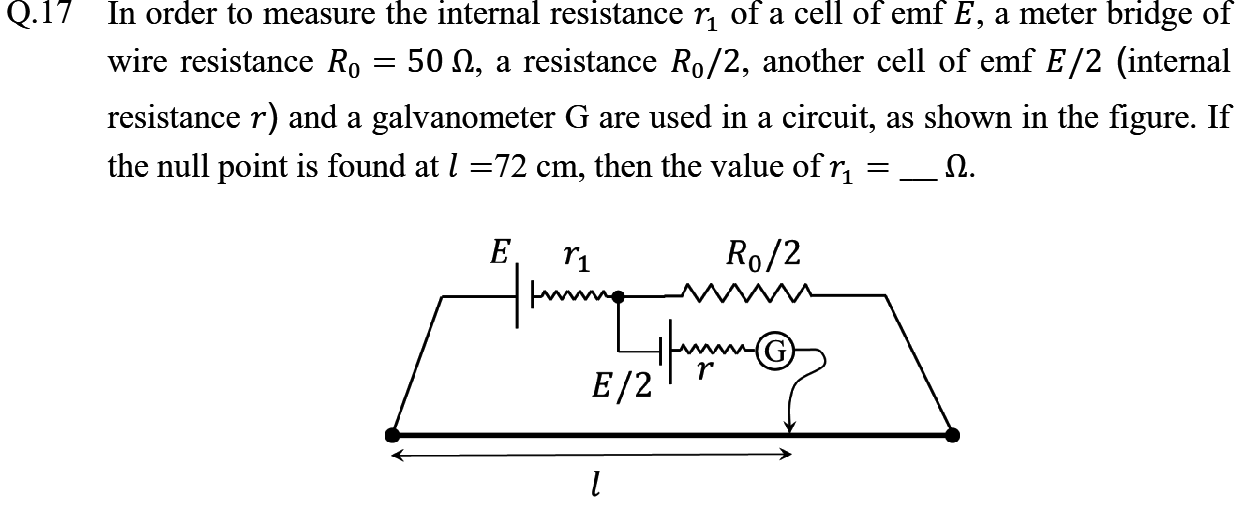
Q4 · PhysicsCurrent ElectricityJEE Advanced 2021 Paper 2Integer answer
Show answer and solution
Correct answer: 3
The null condition gives the potential difference across the wire section (plus $R_0/2$) between the junction and the jockey as $E/2$.
Main loop: $r_1$, $R_0/2$ and the wire $R_0$ are in series with cell $E$.
Given: $R_0=50\ \Omega$, $\dfrac{R_0}{2}=25\ \Omega$, $l=72$ cm
At null point no current flows through G, so the main current is unchanged.
$I=\dfrac{E}{r_1+25+50}=\dfrac{E}{r_1+75}$
Now take the path from the junction to the jockey through $R_0/2$ and the wire length $(100-72)=28$ cm.
Its resistance: $25+50\times\dfrac{28}{100}=25+14=39\ \Omega$
Null condition: p.d. across this path equals $\dfrac{E}{2}$.
$I\times 39=\dfrac{E}{2}$
$\dfrac{39E}{r_1+75}=\dfrac{E}{2}$
$r_1+75=78$
The trick: $E$ and $r$ of the second cell drop out, as no current flows through it at null.
∴ $r_1=3\ \Omega$
Ans: 3
Q5 · ChemistryChemical Kinetics and RadioactivityJEE Advanced 2020 Paper 1Numerical answer

Show answer and solution
Correct answer: 1.19 to 1.21
Each U atom that decays to Pb emits a fixed number of α particles, so first find that number.
α emitted per atom $= \dfrac{238-206}{4} = 8$
Given: $w = 68\times10^{-6}\ \mathrm{g}$, $M = 238\ \mathrm{g\,mol^{-1}}$, $N_A = 6.022\times10^{23}$
$n = \dfrac{68\times10^{-6}}{238} = 2.857\times10^{-7}\ \mathrm{mol}$
$N_0 = 2.857\times10^{-7}\times 6.022\times10^{23} = 1.72\times10^{17}$ atoms
Three half-lives leave $\left(\tfrac12\right)^3 = \tfrac18$, so the fraction decayed is $\tfrac78$.
Atoms decayed $= \tfrac78 \times 1.72\times10^{17} = 1.505\times10^{17}$
The trap here is to count atoms decayed instead of α particles. Each decayed atom gives 8 α.
α particles $= 8 \times 1.505\times10^{17} = 1.204\times10^{18}$
$Z\times10^{18} = 1.2\times10^{18}$
Ans: 1.2
Q6 · MathematicsConic SectionsJEE Advanced 2021 Paper 2Integer answer

Show answer and solution
Correct answer: 4
The midpoints are $M_1=\dfrac{P+Q}{2}$ and $M_2=\dfrac{P+Q'}{2}$, so $P$ cancels in their difference.
$M_1-M_2=\dfrac{Q-Q'}{2}$
⇒ $|M_1M_2|=\dfrac{1}{2}|QQ'|$
Both $Q$ and $Q'$ lie on $E$, so the largest possible $|QQ'|$ is the longest chord, which is the major axis.
Major axis $=2a=2\cdot4=8$
$|M_1M_2|_{max}=\dfrac{8}{2}=4$
The points must be distinct, so $P$ can be any third point on $E$, and $Q,Q'$ can be the two ends of the major axis. The bound is attained.
∴ Maximum distance $=4$
Ans: 4
Q7 · PhysicsFluid MechanicsJEE Advanced 2023 Paper 2Integer answer
Show answer and solution
Correct answer: 25
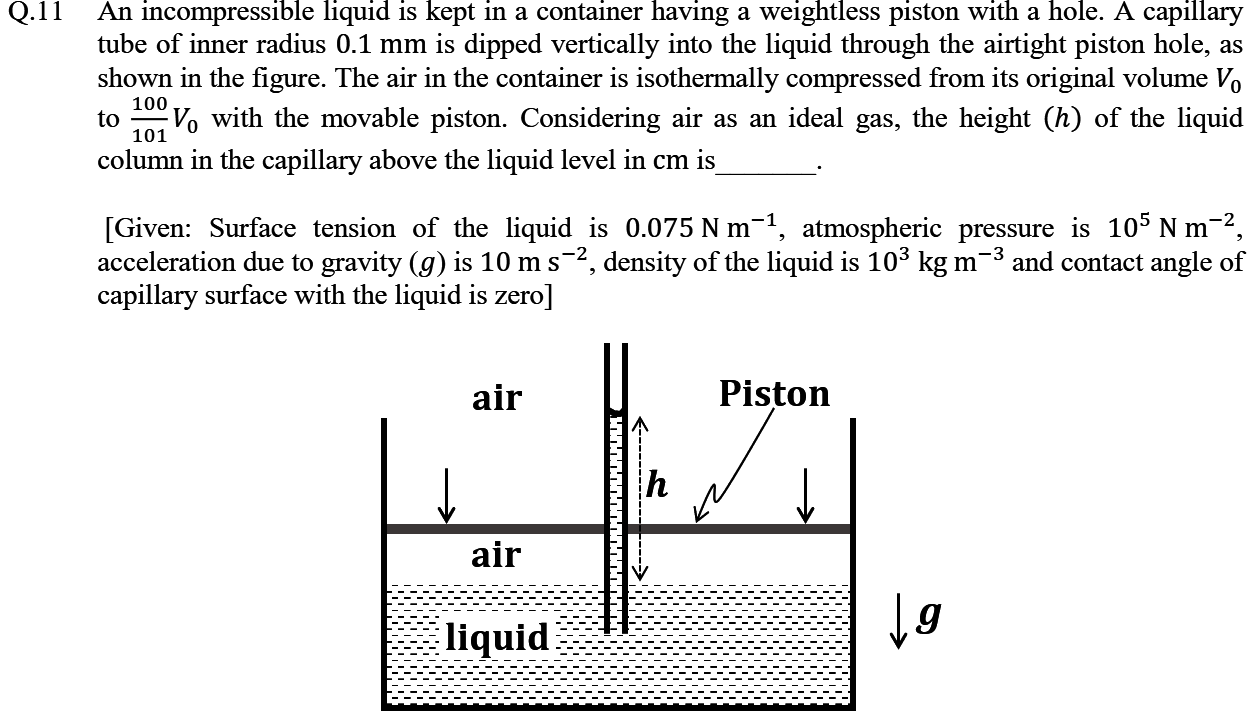
Pressure balance at the liquid level in the container, with the capillary open to the atmosphere at the top.
Air is compressed isothermally, so Boyle's law applies. Initially the weightless piston gives $P_0=10^5\ \mathrm{N\,m^{-2}}$.
Given: $r=10^{-4}\ \mathrm{m}$, $T=0.075\ \mathrm{N\,m^{-1}}$, $\rho=10^3\ \mathrm{kg\,m^{-3}}$, $g=10\ \mathrm{m\,s^{-2}}$, $\theta=0^\circ$
Formula: $P_0V_0=P\cdot\dfrac{100}{101}V_0$
$P=\dfrac{101}{100}\times10^5=1.01\times10^5\ \mathrm{N\,m^{-2}}$
Notice that the capillary top is open, so the pressure just above the meniscus is still $P_0$.
Just below the meniscus: $P_0-\dfrac{2T}{r}$
Pressure at the same level inside the capillary and in the container must be equal (liquid at rest):
$P_0-\dfrac{2T}{r}+\rho g h=P$
$\rho g h=(P-P_0)+\dfrac{2T}{r}$
$\dfrac{2T}{r}=\dfrac{2\times0.075}{10^{-4}}=1500\ \mathrm{N\,m^{-2}}$
$10^4\,h=1000+1500=2500$
$h=0.25\ \mathrm{m}$
This is where students slip: using only $\dfrac{2T}{r\rho g}=15$ cm and forgetting the extra gas pressure on the liquid surface.
∴ $h=25\ \mathrm{cm}$
Ans: 25
Q8 · ChemistryHydrogen & s-Block ElementsJEE Advanced 2020 Paper 1Single correct

Show answer and solution
Correct answer: B
Superoxides on hydrolysis give both $\mathrm{H_2O_2}$ and $\mathrm{O_2}$, since $\mathrm{O_2^-}$ disproportionates.
$\mathrm{2KO_2 + 2H_2O \rightarrow 2KOH + H_2O_2 + O_2}$
Compare the peroxides. Here is the catch: they give only $\mathrm{H_2O_2}$ with cold water, with no free $\mathrm{O_2}$.
$\mathrm{Na_2O_2 + 2H_2O \rightarrow 2NaOH + H_2O_2}$
$\mathrm{Li_2O_2 + 2H_2O \rightarrow 2LiOH + H_2O_2}$
$\mathrm{Pb_3O_4}$ is a mixed oxide, $\mathrm{2PbO\cdot PbO_2}$, and does not hydrolyse in water.
∴ Only $\mathrm{KO_2}$ liberates $\mathrm{O_2}$ directly on hydrolysis.
Ans: (B)
Q9 · MathematicsLimits, Continuity & DifferentiabilityJEE Advanced 2023 Paper 2One or more correct

Show answer and solution
Correct answer: A, B
Since $[4x]$ is constant between multiples of $\tfrac14$, only $x=\tfrac14,\tfrac12,\tfrac34$ can cause trouble.
Write $f(x)=[4x]\,g(x)$ with $g(x)=\left(x-\dfrac14\right)^2\left(x-\dfrac12\right)$
$[4x]=0,1,2,3$ on $(0,\tfrac14)$, $[\tfrac14,\tfrac12)$, $[\tfrac12,\tfrac34)$, $[\tfrac34,1)$
At $x=\tfrac14$: $g(\tfrac14)=0$ ⇒ both sides tend to $0$, so $f$ is continuous
$g'(x)=2\left(x-\tfrac14\right)\left(x-\tfrac12\right)+\left(x-\tfrac14\right)^2$ ⇒ $g'(\tfrac14)=0$
So $f'_-=0\cdot 0=0$ and $f'_+=1\cdot 0=0$ ⇒ differentiable
At $x=\tfrac12$: $g(\tfrac12)=0$ ⇒ continuous
$g'(\tfrac12)=\left(\tfrac14\right)^2=\dfrac1{16}$
$f'_-=1\cdot\dfrac1{16}$, $f'_+=2\cdot\dfrac1{16}$ ⇒ continuous but not differentiable
At $x=\tfrac34$: $g(\tfrac34)=\left(\tfrac12\right)^2\left(\tfrac14\right)=\dfrac1{16}\neq0$
$f(\tfrac34^-)=\dfrac{2}{16}=\dfrac18$, $f(\tfrac34^+)=\dfrac{3}{16}$ ⇒ jump, discontinuous
(A) only $x=\tfrac34$ is a point of discontinuity ⇒ true
(B) only $x=\tfrac12$ is continuous but not differentiable ⇒ true
(C) non-differentiable only at $\tfrac12,\tfrac34$, which is two points ⇒ false
(D) $f<0$ only where $g<0$ with $[4x]\ne0$, i.e. on $[\tfrac14,\tfrac12)$ where $[4x]=1$
$g'(x)=\left(x-\tfrac14\right)\left(3x-\tfrac54\right)=0$ ⇒ $x=\tfrac5{12}$
$g(\tfrac5{12})=\left(\tfrac16\right)^2\left(-\tfrac1{12}\right)=-\dfrac1{432}$
Elsewhere $f\ge0$, so $f_{min}=-\dfrac1{432}\neq-\dfrac1{512}$ ⇒ false
Ans: (A), (B)
Q10 · PhysicsLaws of MotionJEE Advanced 2023 Paper 2Single correct

Show answer and solution
Correct answer: A
Velocity depends on position, so use the chain rule to get acceleration.
Given: $v_x=\alpha y$, $v_y=2\alpha x$
Formula: $\vec F=m\vec a$, $a_x=\dfrac{dv_x}{dt}$, $a_y=\dfrac{dv_y}{dt}$
Now differentiate w.r.t. time, remembering that $x$ and $y$ change with time:
$a_x=\alpha\dfrac{dy}{dt}=\alpha v_y=\alpha(2\alpha x)=2\alpha^2x$
$a_y=2\alpha\dfrac{dx}{dt}=2\alpha v_x=2\alpha(\alpha y)=2\alpha^2y$
$\vec a=2\alpha^2(x\hat x+y\hat y)$
$\vec F=m\vec a=2m\alpha^2(x\hat x+y\hat y)$
The trap: do not just square or differentiate $\vec v$ w.r.t. $x$, $y$ directly. $\dfrac{dy}{dt}$ is $v_y$, not 1.
∴ $\vec F=2m\alpha^2(x\hat x+y\hat y)$
Ans: (A)
Q11 · ChemistryPeriodic Table and Periodicity in PropertiesJEE Advanced 2020 Paper 2Integer answer

Show answer and solution
Correct answer: 9
Look for the alkali metal first, since it shows a huge jump from $I_1$ to $I_2$.
Atom $n+2$: $I_1 = 496$, $I_2 = 4562$ (≈ 9× jump) ⇒ $\mathrm{Na}$ (3s¹ removed, then the 2p⁶ core)
Now $n+2 = 11$ ⇒ $n = 9$. Check with the other three:
$n+3$: $I_1 = 738$, $I_2 = 1451$, then $I_3 = 7733$ (big jump after 2 electrons) ⇒ $\mathrm{Mg}$ (Z = 12) ✓
$n+1$: $I_1 = 2081$ is the highest, a noble gas ⇒ $\mathrm{Ne}$ (Z = 10) ✓
$n$: $I_1 = 1681$, just below Ne ⇒ $\mathrm{F}$ (Z = 9) ✓
The trap is that $I_1$ of F (1681) is below that of Ne (2081), so the order F < Ne < Na < Mg in Z fits the table.
$n = 9$
Ans: 9
Q12 · MathematicsProbabilityJEE Advanced 2023 Paper 2Numerical answer
Show answer and solution
Correct answer: 0.5
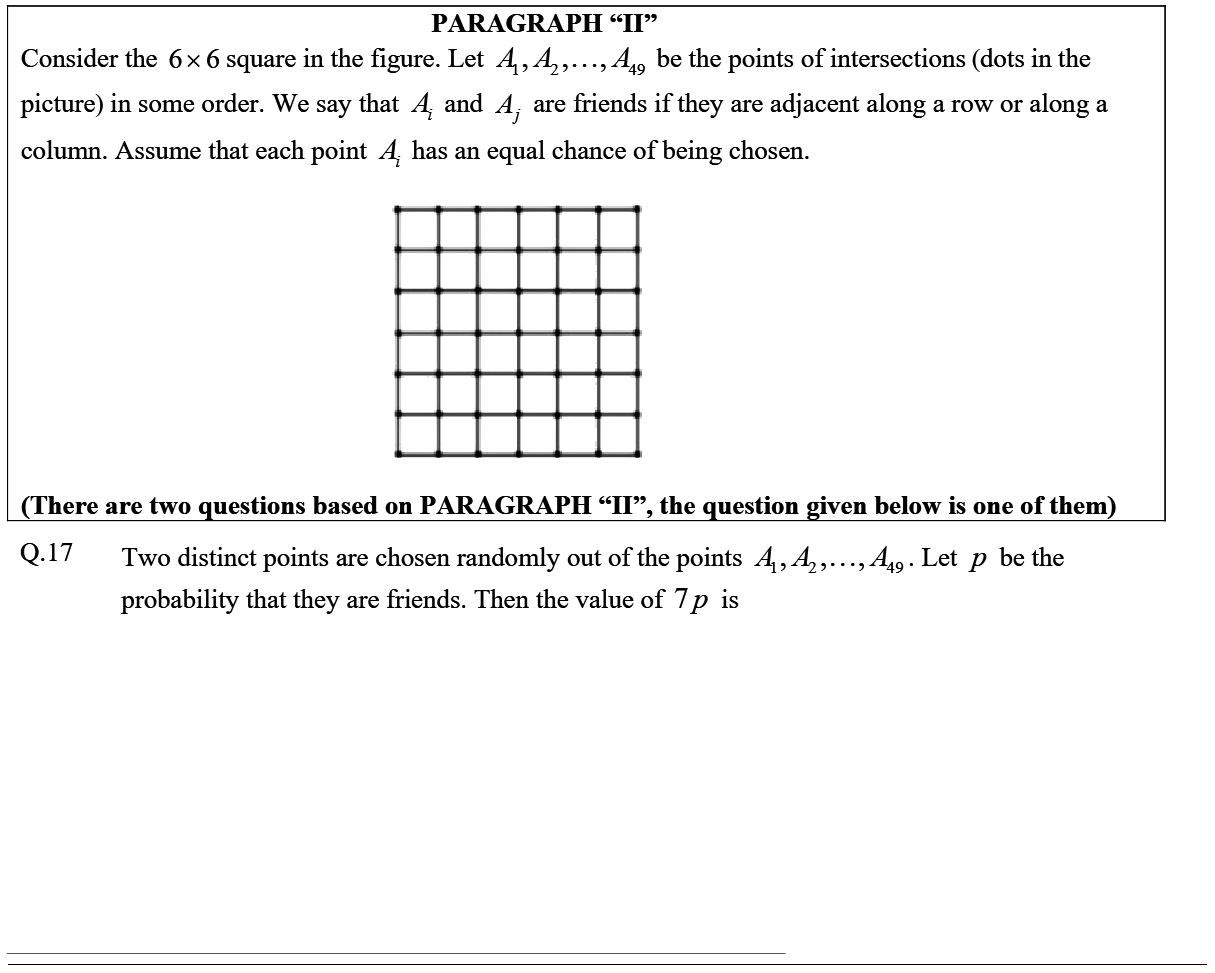
Here the 6×6 square has 7×7 = 49 lattice points, and friends are adjacent points along a row or a column.
Total ways of choosing 2 points: $^{49}C_2=\dfrac{49\cdot 48}{2}=1176$
Favourable pairs, counted row by row and column by column:
Each row has 7 points, so 6 adjacent pairs. With 7 rows: $7\times 6=42$
Each column also gives 42 adjacent pairs.
Favourable: $42+42=84$
$p=\dfrac{84}{1176}=\dfrac{1}{14}$
So $7p=\dfrac{7}{14}=\dfrac{1}{2}$
∴ $7p=\dfrac{1}{2}=0.5$
Ans: 0.5
Q13 · PhysicsOscillations (SHM)JEE Advanced 2023 Paper 1Integer answer

Show answer and solution
Correct answer: 10
Torsional pendulum: $\omega=\sqrt{\kappa/I}$, with $I$ taken about the wire, which passes through the centre of mass.
The masses are unequal, so the COM is not at the rod's midpoint. This is where most students slip.
Given: $m_1=30\ \mathrm{g}=0.03\ \mathrm{kg}$, $m_2=20\ \mathrm{g}=0.02\ \mathrm{kg}$, $L=0.1\ \mathrm{m}$, $\kappa=1.2\times10^{-8}\ \mathrm{N\,m\,rad^{-1}}$
COM from the 30 g mass:
$x_1=\dfrac{m_2L}{m_1+m_2}=\dfrac{0.02\times0.1}{0.05}=0.04\ \mathrm{m}$
So the distance of the 20 g mass is $x_2=0.06\ \mathrm{m}$.
Moment of inertia about the wire:
$I=m_1x_1^2+m_2x_2^2$
$I=0.03(0.04)^2+0.02(0.06)^2$
$I=4.8\times10^{-5}+7.2\times10^{-5}=1.2\times10^{-4}\ \mathrm{kg\,m^2}$
Check: $\mu L^2=\dfrac{0.03\times0.02}{0.05}(0.1)^2=1.2\times10^{-4}$ ✓
$\omega=\sqrt{\dfrac{\kappa}{I}}=\sqrt{\dfrac{1.2\times10^{-8}}{1.2\times10^{-4}}}=\sqrt{10^{-4}}=10^{-2}\ \mathrm{rad\,s^{-1}}$
$\omega=10\times10^{-3}\ \mathrm{rad\,s^{-1}}$
∴ $n=10$
Ans: 10
Q14 · ChemistrySolutionsJEE Advanced 2023 Paper 2Integer answer

Show answer and solution
Correct answer: 682
Osmotic pressure depends on total moles of solute and total volume, since $\Delta_{mix}V = 0$.
Formula: $\pi = CRT = \dfrac{n_{total}}{V_{total}}RT$
Given: $R = 62\ \mathrm{L\,Torr\,K^{-1}mol^{-1}}$, $T = 300\ \mathrm{K}$, $V_1 = 50\ \mathrm{mL}$, $V_2 = 250\ \mathrm{mL}$
Solution 1: take 1 kg solvent, so 0.2 mol urea = 12 g
Mass of solution $= 1000 + 12 = 1012\ \mathrm{g}$
Volume $= \dfrac{1012}{1.012} = 1000\ \mathrm{mL}$, so $M = 0.2\ \mathrm{mol\,L^{-1}}$ (molality ≈ molarity here)
$n_1 = 0.2 \times 0.05 = 0.01\ \mathrm{mol}$
Solution 2: $n_2 = \dfrac{0.06}{60} = 0.001\ \mathrm{mol}$
Mixture: $n_{total} = 0.011\ \mathrm{mol}$, $V_{total} = 300\ \mathrm{mL} = 0.3\ \mathrm{L}$
$C = \dfrac{0.011}{0.3}\ \mathrm{mol\,L^{-1}}$
$\pi = \dfrac{0.011}{0.3} \times 62 \times 300$
$\pi = 0.011 \times 62 \times 1000 = 682\ \mathrm{Torr}$
Ans: 682
Q15 · MathematicsStatisticsJEE Advanced 2026 Paper 2Integer answer

Show answer and solution
Correct answer: 44
Use the sums $\sum x$ and $\sum x^2$, which can be found from the given mean and variance.
All 10 observations: $\sum x_i = 10\times5 = 50$
First 8 observations: $\sum_{1}^{8} x_i = 8\times4 = 32$
⇒ $x_9+x_{10}=18$
Variance formula: $\sigma^2=\dfrac{\sum x^2}{n}-(\bar x)^2$
All 10: $\dfrac{\sum x^2}{10}-25=7$ ⇒ $\sum x^2=320$
First 8: $\dfrac{\sum x^2}{8}-16=3.5$ ⇒ $\sum_{1}^{8}x^2=156$
⇒ $x_9^2+x_{10}^2=164$
Use $2x_9x_{10}=(x_9+x_{10})^2-(x_9^2+x_{10}^2)=324-164=160$
⇒ $x_9x_{10}=80$
So $x_9,x_{10}$ are roots of $t^2-18t+80=0$ ⇒ $t=8,\,10$
Given $x_9<x_{10}$ ⇒ $x_9=8,\ x_{10}=10$
∴ $3x_9+2x_{10}=24+20=44$
Ans: 44