Hell–Volhard–Zelinsky (HVZ) Reaction
JEE Main + AdvancedWhat is the Hell–Volhard–Zelinsky (HVZ) Reaction?
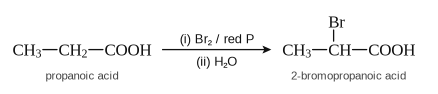
Carboxylic acids having an α-hydrogen are halogenated at the α-position on treatment with chlorine or bromine in the presence of a small amount of red phosphorus (or PX3), followed by water. The acyl halide formed in situ enolises much more easily than the acid.
Reagents and conditions
- X₂ (Cl₂ / Br₂)
- red P (cat.) → PX₃
- then H₂O
- needs α-H
Example
Mechanism of the Hell–Volhard–Zelinsky (HVZ) Reaction
Red P + Br2 → PBr3, which converts the acid into the acyl bromide.

The acyl bromide tautomerises to its enol (acid-catalysed by HBr). Enolisation is the slow, rate-determining step.slow step

The electron-rich enol C=C attacks Br2; loss of H+ gives the α-bromo acyl bromide.

Hydrolysis (or exchange with more RCH2COOH) gives the α-bromo acid.

Shortcut to write the product
- Replace one α-H by X; keep COOH. Excess X2 → α,α-dihalo acid.
- No α-H → no HVZ: HCOOH, C6H5COOH, (CH3)3CCOOH. Ring H is not α-H.
- α-Halo acid is a gateway: + NH3 → α-amino acid; + KCN → cyano acid; + alc. KOH → α,β-unsaturated acid.
JEE practice question
Which of the following does NOT undergo the HVZ reaction?
- propanoic acid
- 2-methylpropanoic acid
- 2,2-dimethylpropanoic acid
- phenylacetic acid
Show answer
Answer (c) — 2,2-Dimethylpropanoic acid, (CH3)3C–COOH, has no hydrogen on the α-carbon, so no enol can form.