Arndt–Eistert Homologation
JEE AdvancedWhat is the Arndt–Eistert Homologation?
A carboxylic acid is converted into its next higher homologue (one extra CH2). The acid chloride reacts with diazomethane to give a diazoketone, which in the presence of Ag2O and water undergoes the Wolff rearrangement to a ketene; water adds to the ketene to give the homologous acid.
Reagents and conditions
- SOCl₂ → RCOCl
- CH₂N₂ (2 equiv.)
- Ag₂O, H₂O, Δ (Wolff rearrangement)
Example

Mechanism of the Arndt–Eistert Homologation
The carbon of CH2N2 attacks the acyl chloride; Cl− is lost; a second CH2N2 removes H+ (→ CH3Cl + N2), giving the diazoketone.

Wolff rearrangement (Ag+, heat): N2 leaves as R migrates from the carbonyl carbon to the diazo carbon → ketene. This is the slow step.slow step
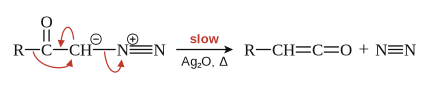
Water adds across the ketene C=C → homologous carboxylic acid (ROH → ester, NH3 → amide).

Shortcut to write the product
- R–COOH → R–CH2–COOH: insert one CH2 between R and COOH.
- Carbon-count ladder: Arndt–Eistert +1 C; Hunsdiecker / Hofmann / Curtius / Schmidt −1 C.
- A chiral R migrates with retention.
JEE practice question
Benzoic acid is subjected to Arndt–Eistert synthesis (SOCl2; CH2N2; Ag2O / H2O). The product is:
- phenylacetic acid
- benzoic acid (unchanged)
- 3-phenylpropanoic acid
- acetophenone
Show answer
Answer (a) — One CH2 is inserted between the ring and COOH: C6H5COOH → C6H5CH2COOH.