Named Reactions › Part F: Rearrangements
Schmidt Reaction
JEE AdvancedWhat is the Schmidt Reaction?
Carboxylic acids react with hydrazoic acid (HN3) in the presence of conc. H2SO4 to give primary amines with one carbon less, CO2 and N2. Ketones under the same conditions give amides (like Beckmann).
Reagents and conditions
- HN₃ (NaN₃ + H₂SO₄)
- conc. H₂SO₄
- RCOOH → RNH₂ + CO₂ + N₂
Example
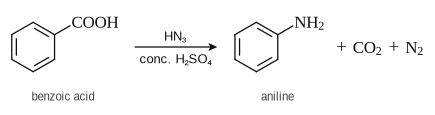
Mechanism of the Schmidt Reaction
Protonated acid loses water → acylium ion; HN3 adds to it → protonated acyl azide.

R migrates from C to N with loss of N2 → protonated isocyanate (slow step).slow step

Water adds; the carbamic acid loses CO2 → amine (as ammonium salt in acid).

Shortcut to write the product
- RCOOH → RNH2 in one pot (one carbon less) — no need to make the amide or azide first.
- Ketone + HN3 → amide: the larger / aryl group ends on N (PhCOCH3 → CH3CONHPh).
JEE practice question
Benzoic acid is treated with HN3 in conc. H2SO4. The organic product after work-up is:
- benzamide
- aniline
- benzonitrile
- phenyl isocyanide
Show answer
Answer (b) — Schmidt reaction: acyl azide → phenyl isocyanate (Ph migrates, N2 lost) → hydrolysis → aniline + CO2.
📘 Study all 57 named reactions with mechanisms in the free 60 Minutes to JEE Named Reactions Handbook.