Named Reactions › Part B: Aromatic Substitution & Benzene Derivatives
Gattermann–Koch Reaction
JEE MainWhat is the Gattermann–Koch Reaction?
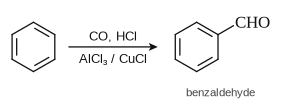
Benzene (or an alkylbenzene) treated with carbon monoxide and HCl under pressure in the presence of anhydrous AlCl3 and CuCl gives an aromatic aldehyde. It is a Friedel–Crafts type formylation; the electrophile is the formyl cation H–C≡O+.
Reagents and conditions
- CO + HCl (high pressure)
- anhydrous AlCl₃ / CuCl
- not for phenols / phenol ethers
Example
Mechanism of the Gattermann–Koch Reaction
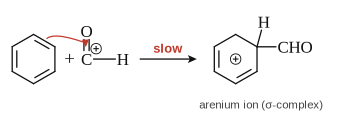
CO + HCl (with AlCl3) form the formyl cation: CO + HCl + AlCl3 → H–C≡O+ + AlCl4− (CuCl helps by binding CO).

π electrons of the ring attack the formyl carbon → arenium ion (slow, rate-determining).slow step
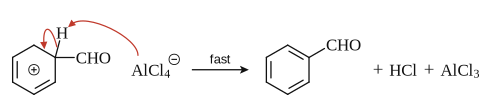
AlCl4− removes H+; aromaticity is restored.
Shortcut to write the product
- Ring–H → ring–CHO. With an o/p-director already present (CH3, Cl), CHO goes mainly para.
- Gattermann–Koch (CO + HCl) ≠ Gattermann reaction (ArN2+ + Cu/HX, Part H) ≠ Gattermann aldehyde synthesis (HCN + HCl, for phenols).
JEE practice question
Toluene on Gattermann–Koch formylation gives mainly:
- benzaldehyde
- p-tolualdehyde (4-methylbenzaldehyde)
- m-tolualdehyde
- phenylacetaldehyde
Show answer
Answer (b) — CH3 is an o/p-director; the bulky formylation goes para. The ring, not the side chain, is substituted.
📘 Study all 57 named reactions with mechanisms in the free 60 Minutes to JEE Named Reactions Handbook.