Birch Reduction
JEE AdvancedWhat is the Birch Reduction?
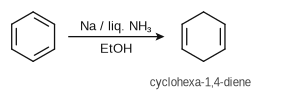
Aromatic rings are reduced by an alkali metal (Na or Li) in liquid ammonia in the presence of an alcohol to non-conjugated cyclohexa-1,4-dienes. Electrons from the dissolved metal and protons from the alcohol are added alternately.
Reagents and conditions
- Na or Li
- liquid NH₃ (−33 °C)
- EtOH or t-BuOH (proton source)
Example
Mechanism of the Birch Reduction
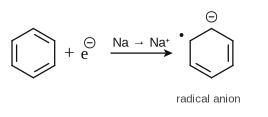
One electron from Na enters the ring → radical anion.
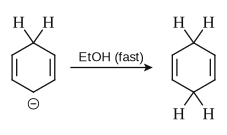
The carbanion carbon is protonated by EtOH → cyclohexadienyl radical. This first protonation is the slow, rate-determining step.slow step

A second electron gives a pentadienyl anion; protonation at the central carbon (para to the first CH2) gives the 1,4-diene.
Shortcut to write the product
- Two opposite (1,4) ring carbons become CH2; the other four keep two C=C — never conjugated.
- Electron-donating group (–OCH3, –CH3): stays on a double-bond carbon (1-substituted-1,4-diene).
- Electron-withdrawing group (–COOH): ends on an sp3 carbon (cyclohexa-2,5-diene-1-carboxylic acid).
- Na/liq. NH3 also reduces alkynes to trans-alkenes.
JEE practice question
Anisole (methoxybenzene) is treated with Na in liquid NH3 and ethanol. The product is:
- 1-methoxycyclohexa-1,4-diene
- 3-methoxycyclohexa-1,4-diene
- 1-methoxycyclohexa-1,3-diene
- methoxycyclohexane
Show answer
Answer (a) — OCH3 is electron-donating, so it remains on a C=C carbon; the reduced CH2 groups are 1,4 to each other (non-conjugated diene).