Named Reactions › Part B: Aromatic Substitution & Benzene Derivatives
Friedel–Crafts Acylation
JEE Main + AdvancedWhat is the Friedel–Crafts Acylation?
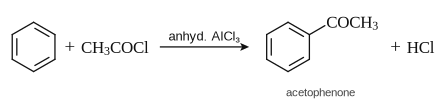
Benzene reacts with an acid chloride or acid anhydride in the presence of anhydrous AlCl3 to give an aryl ketone. The electrophile is the resonance-stabilised acylium ion R–C≡O+, which does not rearrange.
Reagents and conditions
- RCOCl or (RCO)₂O
- anhydrous AlCl₃ (slightly > 1 equiv.)
- then H₂O work-up
Example
Mechanism of the Friedel–Crafts Acylation
AlCl3 removes chloride from the acid chloride, giving the acylium ion.

Benzene π electrons attack the acylium carbon → arenium ion (slow, rate-determining).slow step
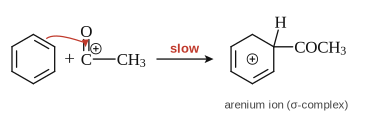
Loss of H+ to AlCl4− restores aromaticity; the ketone is released from its AlCl3 complex on adding water.

Shortcut to write the product
- Attach the whole acyl group R–C(=O)– to the ring; the carbonyl carbon bonds to the ring. No rearrangement, no poly-acylation (C=O deactivates the ring).
- To get an n-alkylbenzene without rearrangement: acylate, then Clemmensen / Wolff–Kishner (C=O → CH2).
- With cyclic anhydrides (succinic) → keto-acid (ring-closing route to α-tetralone).
JEE practice question
The best way to prepare n-propylbenzene from benzene is:
- CH3CH2CH2Cl / AlCl3
- CH3CH2COCl / AlCl3, then Zn–Hg / conc. HCl
- CH3CH=CH2 / H3PO4
- CH3CH2CH2OH / conc. H2SO4
Show answer
Answer (b) — The acylium ion does not rearrange, giving propiophenone; Clemmensen reduces C=O to CH2. (a), (c), (d) all form the 2° cation → cumene.
📘 Study all 57 named reactions with mechanisms in the free 60 Minutes to JEE Named Reactions Handbook.