Named Reactions › Part D: Aldehydes & Ketones — Reduction / Oxidation
Etard Reaction
JEE MainWhat is the Etard Reaction?
Chromyl chloride (CrO2Cl2) in CS2 or CCl4 oxidises the methyl group of toluene to a chromium complex (the Etard complex), which on hydrolysis gives benzaldehyde. Oxidation stops at the aldehyde stage.
Reagents and conditions
- CrO₂Cl₂
- CS₂ (or CCl₄)
- then H₃O⁺
- Ar–CH₃ → Ar–CHO
Example
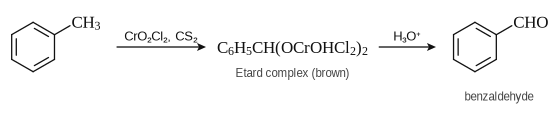
Mechanism of the Etard Reaction
Two molecules of CrO2Cl2 attack the benzylic C–H bonds (the benzylic radical/cation is stabilised by the ring), giving the brown Etard complex C6H5CH(OCrOHCl2)2 — an acetal-like derivative at the aldehyde oxidation level.

Hydrolysis breaks the two C–O–Cr bonds and releases the aldehyde.

Detailed electron flow is not required in JEE.
Shortcut to write the product
- Ring–CH3 → ring–CHO; ring substituents unchanged.
- Strong oxidants (KMnO4, K2Cr2O7) go to –COOH. CrO3 / (CH3CO)2O then H3O+ also gives ArCHO (via the gem-diacetate).
JEE practice question
Toluene is converted into benzaldehyde (and not benzoic acid) by:
- alkaline KMnO4, then H3O+
- CrO2Cl2 in CS2, then H3O+
- acidified K2Cr2O7
- conc. HNO3
Show answer
Answer (b) — Etard reaction: the chromyl chloride complex is at the aldehyde oxidation level and hydrolyses to C6H5CHO.
📘 Study all 57 named reactions with mechanisms in the free 60 Minutes to JEE Named Reactions Handbook.