Meerwein–Ponndorf–Verley (MPV) Reduction
JEE AdvancedWhat is the Meerwein–Ponndorf–Verley (MPV) Reduction?
Aldehydes and ketones are reduced to the corresponding alcohols by aluminium isopropoxide in isopropyl alcohol. A hydride is transferred from the isopropoxide to the carbonyl carbon, and acetone is formed (distilled off to drive the equilibrium). It is highly chemoselective: C=C, NO2, ester groups are not reduced.
Reagents and conditions
- Al(O-iPr)₃
- (CH₃)₂CHOH (solvent)
- distil off acetone
- reverse of Oppenauer
Example

Mechanism of the Meerwein–Ponndorf–Verley (MPV) Reduction
The carbonyl oxygen coordinates to aluminium of the isopropoxide.

In a six-membered cyclic transition state, the C–H hydride of the isopropoxide is delivered to the carbonyl carbon (slow, rate-determining hydride transfer); the isopropoxide carbon becomes acetone.slow step
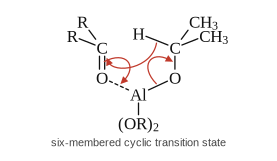
The new aluminium alkoxide exchanges with iPrOH; the product alcohol is released after hydrolysis.

Shortcut to write the product
- C=O → CH–OH only; C=C, C≡C, –NO2, –COOR, –X untouched.
- Aldehyde → 1° alcohol, ketone → 2° alcohol; isopropanol → acetone (by-product).
- Reverse reaction with excess acetone = Oppenauer oxidation.
JEE practice question
Cinnamaldehyde (C6H5CH=CH–CHO) is heated with aluminium isopropoxide in isopropanol. The product is:
- C6H5CH=CH–CH2OH
- C6H5CH2CH2CH2OH
- C6H5CH2CH2CHO
- C6H5CH=CH–COOH
Show answer
Answer (a) — MPV reduces only the C=O group by hydride transfer; the conjugated C=C remains → cinnamyl alcohol.