Benzilic Acid Rearrangement
JEE AdvancedWhat is the Benzilic Acid Rearrangement?
The base-catalysed conversion of a 1,2-diketone into the salt of a 2-hydroxy carboxylic acid (α-hydroxy acid) is known as the benzilic acid rearrangement. One carbonyl carbon becomes COO− and the other becomes the carbinol carbon after a 1,2-shift of an aryl/alkyl group. The reaction is not useful for 1,2-diketones containing an α-CH2 group, because base-induced aldol condensation competes.
Reagents and conditions
- KOH or NaOH (aq./alc.)
- heat (Δ)
- then H₃O⁺ to free the acid
- substrate: non-enolisable 1,2-diketone
Example

Mechanism of the Benzilic Acid Rearrangement
OH− adds to one carbonyl carbon to give a tetrahedral alkoxide (reversible).
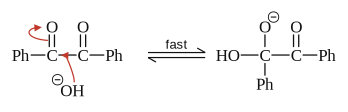
The O− re-forms C=O while the phenyl on that carbon migrates, with its bonding pair, to the neighbouring carbonyl carbon. This 1,2-phenyl shift is the slow, rate-determining step.slow step
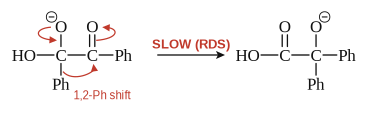
Fast proton transfer gives the stable carboxylate (benzilate) ion; acidification gives benzilic acid.

Shortcut to write the product
- Write R–CO–CO–R′ → R(R′)C(OH)–COO−: both groups end on the same carbon, which carries OH; the other carbon becomes COO−.
- Carbon count is unchanged — no carbon is lost or gained.
- Cyclic 1,2-diketones contract the ring by one carbon: cyclohexane-1,2-dione → 1-hydroxycyclopentane-1-carboxylate.
- With OR− (e.g. MeO−) in place of OH− the product is the ester R2C(OH)COOMe (benzilic ester rearrangement).
JEE practice question
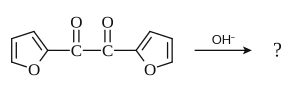
Find out the product of the following reaction (furil + hydroxide):
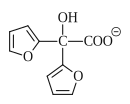
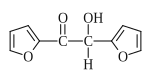
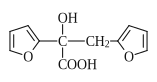
- None of these
Show answer
Answer (a) — Furil is a 1,2-diketone with no α-H (both C=O carbons carry furan ring carbons), so OH− triggers a benzilic acid rearrangement: one 2-furyl group migrates, giving (2-furyl)2C(OH)COO− (furilate). (b) is furoin, a reduction product; (c) has the wrong carbon skeleton.