Beckmann Rearrangement
JEE AdvancedWhat is the Beckmann Rearrangement?
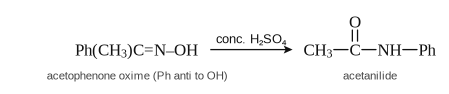
Ketoximes treated with acidic reagents (conc. H2SO4, PCl5, SOCl2, polyphosphoric acid) rearrange to N-substituted amides. The group anti (trans) to the –OH on nitrogen migrates from carbon to nitrogen.
Reagents and conditions
- ketoxime R(R′)C=N–OH
- conc. H₂SO₄ / PCl₅ / SOCl₂
- then H₂O
Example
Mechanism of the Beckmann Rearrangement
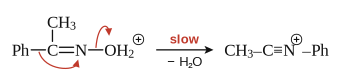
The oxime OH is protonated (or converted into a better leaving group by PCl5).

The group anti to the leaving group migrates to N at the same time as water leaves (concerted) → nitrilium ion. This is the slow, rate-determining step.slow step
Water attacks the nitrilium carbon; loss of H+ gives the imidic acid, which tautomerises to the amide.

In the linear drawing Ph is the group anti (trans) to OH.
Shortcut to write the product
- Insert NH between C=O and the anti group: R(anti)–C(=NOH)–R′ → R–NH–CO–R′.
- Anti group migrates with retention; the other group stays on the carbonyl carbon.
- Cyclic ketoxime → ring-expanded lactam: cyclohexanone oxime → ε-caprolactam (monomer of nylon-6).
- Aldoximes usually dehydrate to nitriles (R–C≡N) instead.
JEE practice question
Cyclohexanone oxime is heated with conc. H2SO4. The product is the monomer of:
- nylon-6,6
- nylon-6
- Terylene
- Bakelite
Show answer
Answer (b) — Beckmann rearrangement inserts N into the ring → ε-caprolactam (7-membered lactam), which polymerises to nylon-6.