Pinacol–Pinacolone Rearrangement
JEE AdvancedWhat is the Pinacol–Pinacolone Rearrangement?
1,2-Diols (vicinal diols, pinacols) on treatment with acid (conc. H2SO4) rearrange to ketones or aldehydes. One OH is lost as water to give a carbocation; a group on the neighbouring carbon migrates (1,2-shift) and the remaining OH becomes C=O. Pinacol (2,3-dimethylbutane-2,3-diol) gives pinacolone (3,3-dimethylbutan-2-one).
Reagents and conditions
- vicinal diol
- conc. H₂SO₄ (or H⁺)
- heat
Example
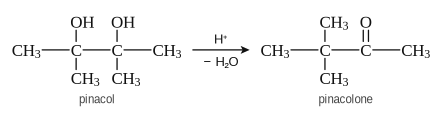
Mechanism of the Pinacol–Pinacolone Rearrangement
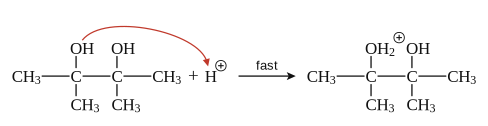
One OH is protonated (the one whose loss gives the more stable carbocation).
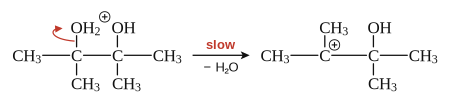
Water leaves → tertiary carbocation. Carbocation formation is the slow, rate-determining step.slow step
1,2-Methyl shift from the carbinol carbon to C+, assisted by the O lone pair → resonance-stabilised oxocarbenium ion.
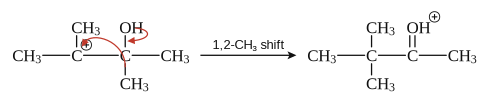
Loss of H+ from oxygen gives the ketone (pinacolone).

Shortcut to write the product
- Decide which OH leaves: the one giving the more stable cation (Ph2C+ > 3° > 2°).
- From the other carbon a group migrates to C+; the carbon that keeps the OH becomes C=O. Migratory aptitude: H ≈ Ar > 3° > 2° > 1° alkyl > CH3 (p-MeO-C6H4 > Ph).
- Cyclic diols can give ring expansion / spiro ketones.
JEE practice question
Ph2C(OH)–C(OH)(CH3)2 is warmed with conc. H2SO4. The major product is:
- Ph2C(CH3)–CO–CH3
- PhCO–C(CH3)2Ph
- Ph2C=C(CH3)2
- (CH3)2C(Ph)–CO–Ph
Show answer
Answer (a) — The OH on CPh2 leaves (diphenyl carbocation is most stable). A CH3 migrates from the other carbon, which becomes C=O → 3,3-diphenylbutan-2-one.