Coupling Reaction (Azo Coupling)
JEE MainWhat is the Coupling Reaction (Azo Coupling)?
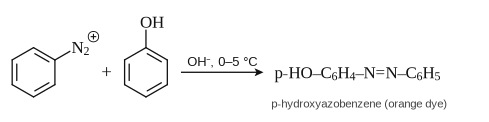
Benzenediazonium chloride reacts with phenol in mildly alkaline medium (or with aniline in mildly acidic medium) to give brightly coloured azo compounds. The diazonium ion is a weak electrophile and attacks the activated ring, mainly at the para position.
Reagents and conditions
- ArN₂⁺Cl⁻ (0–5 °C)
- phenol: pH 9–10 (NaOH)
- aniline: pH 4–5
- para (ortho if para blocked)
Example
Mechanism of the Coupling Reaction (Azo Coupling)
The phenoxide ion (shown in its resonance form with the negative charge on the para carbon) attacks the terminal N of the diazonium ion; N≡N π electrons move to N+. Formation of this σ-complex is the slow step.slow step
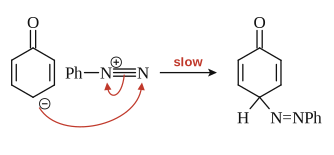
Loss of the ring proton (fast) restores aromaticity and gives the azo phenoxide / p-hydroxyazobenzene.

Shortcut to write the product
- Write Ar–N=N– on the para carbon of the phenol / aniline (ortho if para is occupied). N2 is retained.
- pH window: phenols need alkali (phenoxide is the active nucleophile); amines need weak acid (too much acid protonates –NH2).
- Diazonium salts lose N2 (Sandmeyer etc.) but keep it in coupling.
JEE practice question
Benzenediazonium chloride is coupled with p-cresol (4-methylphenol) in alkaline solution. The product is:
- 4-methyl-2-(phenylazo)phenol
- 4-(phenylazo)phenol
- 3-methyl-4-(phenylazo)phenol
- 4-methylbiphenyl
Show answer
Answer (a) — The para position is occupied by CH3, so coupling occurs ortho to the activating –O− group.