Dakin Reaction
JEE AdvancedWhat is the Dakin Reaction?
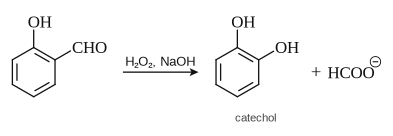
An o- or p-hydroxy (or amino) benzaldehyde / aryl ketone is oxidised by alkaline hydrogen peroxide to a benzenediol (and a carboxylate). The –CHO group is replaced by –OH through an aryl migration from C to O, as in the Baeyer–Villiger oxidation.
Reagents and conditions
- H₂O₂
- aq. NaOH
- substrate: o-/p-OH or –NH₂ substituted ArCHO / ArCOR
Example
Mechanism of the Dakin Reaction
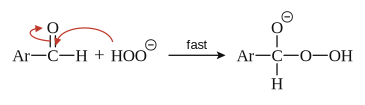
HOO− adds to the carbonyl carbon (fast) → tetrahedral peroxy-alkoxide.
The O− re-forms C=O, the aryl group migrates from C to O and OH− leaves (O–O bond breaks). This migration is the slow, rate-determining step; the electron-rich (o/p-OH) ring migrates readily.slow step
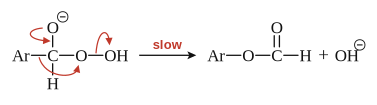
The aryl formate is hydrolysed by OH− → phenoxide + formate; acidification gives the diol.

Ar = 2- or 4-hydroxyphenyl. The –OH group must be ortho or para to –CHO.
Shortcut to write the product
- Replace –CHO by –OH: o-hydroxybenzaldehyde → catechol; p-hydroxybenzaldehyde → hydroquinone.
- Aryl ketone ArCOCH3 → ArOH + CH3COO− (aryl migrates in preference to methyl).
- Same logic as Baeyer–Villiger: the group that migrates ends up on oxygen.
JEE practice question
4-Hydroxybenzaldehyde is treated with H2O2 in aqueous NaOH. The aromatic product is:
- 4-hydroxybenzoic acid
- benzene-1,4-diol (hydroquinone)
- benzene-1,2-diol (catechol)
- 4-hydroxybenzyl alcohol
Show answer
Answer (b) — Dakin oxidation: the aryl group migrates to O, so –CHO is replaced by –OH at the same position (para) → hydroquinone; carbon leaves as formate.