Clemmensen Reduction
JEE MainWhat is the Clemmensen Reduction?
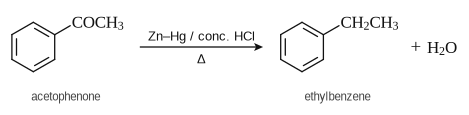
The carbonyl group of aldehydes and ketones is reduced to a CH2 group by zinc amalgam and concentrated hydrochloric acid. It is used for substrates that are stable to strong acid.
Reagents and conditions
- Zn–Hg (zinc amalgam)
- conc. HCl
- reflux
- >C=O → >CH₂
Example
Mechanism of the Clemmensen Reduction
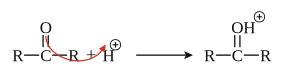
Protonation of the carbonyl oxygen by HCl activates the C=O group.
Electrons are transferred from the zinc surface; C–O bonds are broken and water is lost, giving a zinc-bound carbenoid R2C=Zn on the surface.

Two further protonations / electron transfers convert the carbenoid into the CH2 group.

The mechanism occurs on the metal surface and is not fully established; JEE asks only the product and conditions. Alcohols are NOT intermediates.
Shortcut to write the product
- C=O → CH2; everything else in the molecule stays (–COOH, –COOR are not reduced).
- Acid-sensitive molecules (alcohols that dehydrate, acetals) → use Wolff–Kishner (base) instead.
- FC acylation + Clemmensen = clean route to n-alkylbenzenes.
JEE practice question
CH3COCH2CH2COOH (levulinic acid) is heated with Zn–Hg / conc. HCl. The product is:
- pentanoic acid
- 4-hydroxypentanoic acid
- pentane
- pentan-1-ol
Show answer
Answer (a) — Only the ketone C=O becomes CH2; the carboxylic acid group is not reduced by Clemmensen conditions → CH3CH2CH2CH2COOH.