Named Reactions › Part A: Haloalkanes, Ethers & Organometallics
Williamson Ether Synthesis
JEE MainWhat is the Williamson Ether Synthesis?
An alkoxide or phenoxide ion reacts with a primary alkyl halide by an SN2 reaction to form an ether. Both symmetrical and unsymmetrical ethers can be made.
Reagents and conditions
- R–O⁻Na⁺ (from ROH + Na / NaH)
- 1° alkyl halide (CH₃X best)
- SN2
Example
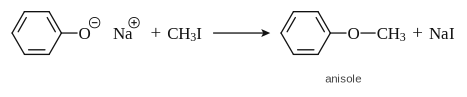
Mechanism of the Williamson Ether Synthesis
The alkoxide oxygen attacks the alkyl carbon from the back side while the halide leaves — one concerted SN2 step (rate-determining).slow step

Shortcut to write the product
- Break the ether into R–O− + R′–X. Put the halogen on the less hindered carbon (CH3 or 1°); the bulky group goes on oxygen.
- 3° halide + alkoxide → alkene (E2), not ether. Aryl halides do not undergo SN2: use phenoxide + alkyl halide.
JEE practice question
The best method to prepare tert-butyl methyl ether is:
- (CH3)3C–ONa + CH3Br
- (CH3)3C–Br + CH3ONa
- both (a) and (b) equally
- (CH3)3C–OH + CH3OH, conc. H2SO4, 413 K
Show answer
Answer (a) — SN2 needs an unhindered halide (CH3Br). With (CH3)3CBr, CH3O− acts as a base → isobutylene (E2).
📘 Study all 57 named reactions with mechanisms in the free 60 Minutes to JEE Named Reactions Handbook.