Named Reactions › Part A: Haloalkanes, Ethers & Organometallics
Kolbe Electrolysis
JEE MainWhat is the Kolbe Electrolysis?
Electrolysis of a concentrated aqueous solution of the sodium or potassium salt of a carboxylic acid gives an alkane at the anode formed by joining two alkyl groups after loss of CO2. Hydrogen is evolved at the cathode.
Reagents and conditions
- aq. RCOONa / RCOOK
- electrolysis (Pt electrodes)
- 2RCOONa + 2H₂O → R–R + 2CO₂ + H₂ + 2NaOH
Example

Mechanism of the Kolbe Electrolysis
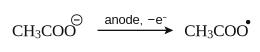
At the anode the carboxylate loses one electron: RCOO− → RCOO• + e−.
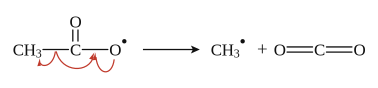
The carboxyl radical loses CO2, giving a methyl radical.
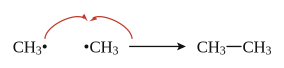
Two alkyl radicals combine at the electrode surface.
Cathode: 2H2O + 2e− → H2 + 2OH−.
Shortcut to write the product
- Cut off COO⁻ from two salts and join the two R groups: 2 RCOO− → R–R (even carbon alkane, 2 × (n−1) C).
- Mixture of two salts → three alkanes (R–R, R′–R′, R–R′).
- Salts of diacids give alkenes/alkynes: sodium succinate → ethene; sodium maleate/fumarate → ethyne.
JEE practice question
Electrolysis of aqueous sodium propanoate gives at the anode:
- ethane + CO2
- n-butane + CO2
- propane + CO2
- n-hexane + CO2
Show answer
Answer (b) — CH3CH2COO− → C2H5• + CO2; two ethyl radicals → CH3CH2CH2CH3.
📘 Study all 57 named reactions with mechanisms in the free 60 Minutes to JEE Named Reactions Handbook.