Named Reactions › Part C: Phenols
Kolbe–Schmitt Reaction (Kolbe's reaction)
JEE MainWhat is the Kolbe–Schmitt Reaction (Kolbe's reaction)?
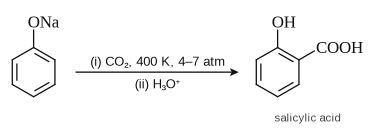
Sodium phenoxide heated with carbon dioxide under pressure (≈ 400 K, 4–7 atm) gives sodium salicylate, which on acidification yields salicylic acid (2-hydroxybenzoic acid). The phenoxide ion is a stronger nucleophile than phenol and attacks the weak electrophile CO2.
Reagents and conditions
- C₆H₅ONa
- CO₂, 400 K, 4–7 atm
- then H₃O⁺
Example
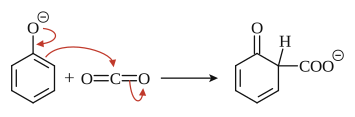
Mechanism of the Kolbe–Schmitt Reaction (Kolbe's reaction)
The ortho carbon of phenoxide attacks the carbon of CO2; a C=O π pair moves onto oxygen.
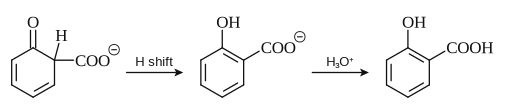
Tautomerisation (H shift) restores aromaticity → salicylate; acid work-up gives salicylic acid.
Na+ chelates the phenoxide O and CO2, favouring ortho attack. No slow step is examined.
Shortcut to write the product
- Phenoxide + CO2 → COOH ortho to OH (one carbon added).
- Potassium phenoxide at higher temperature (≈ 510 K) gives mainly the para acid (p-hydroxybenzoic acid).
- Not to be confused with Kolbe electrolysis (Part A), which removes CO2.
JEE practice question
Sodium phenoxide is heated with CO2 at 400 K and 4–7 atm, then acidified. The product is:
- salicylic acid
- p-hydroxybenzoic acid
- benzoic acid
- diphenyl carbonate
Show answer
Answer (a) — Kolbe–Schmitt carboxylation of sodium phenoxide occurs ortho (Na+ chelation) → 2-hydroxybenzoic acid.
📘 Study all 57 named reactions with mechanisms in the free 60 Minutes to JEE Named Reactions Handbook.