Fries Rearrangement
JEE AdvancedWhat is the Fries Rearrangement?
A phenyl ester heated with anhydrous AlCl3 rearranges to a mixture of o- and p-hydroxyaryl ketones. The acyl group moves from the phenolic oxygen to the ring. Low temperature favours the para product; high temperature favours the ortho product.
Reagents and conditions
- phenyl ester ArOCOR
- anhydrous AlCl₃
- < 60 °C → para
- > 160 °C → ortho
- then H₃O⁺
Example
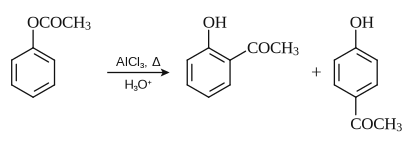
Mechanism of the Fries Rearrangement
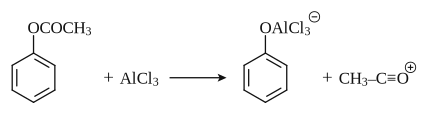
AlCl3 coordinates to the ester oxygen; the O–acyl bond breaks to release an acylium ion and an aluminium phenoxide.
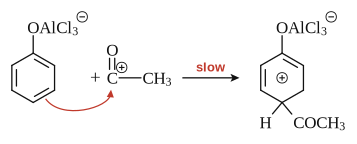
The acylium ion attacks the activated ring (para attack shown; ortho is similar) — Friedel–Crafts acylation; this σ-complex formation is the slow step.slow step
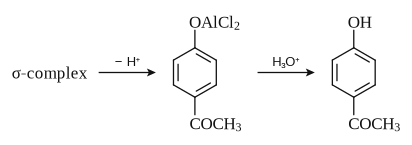
Loss of H+ and hydrolysis of the O–Al bond give the hydroxy ketone.
Shortcut to write the product
- Move the acyl group from O to the ring ortho or para; the O becomes –OH. Molecular formula unchanged (isomerisation).
- Temperature rule: low T → para (kinetic); high T → ortho (thermodynamic, stabilised by Al chelation / H-bonding between OH and C=O).
- Photo-Fries: same products by UV light (radical pathway).
JEE practice question
Phenyl acetate is heated with anhydrous AlCl3 at 165 °C and then hydrolysed. The major product is:
- p-hydroxyacetophenone
- o-hydroxyacetophenone
- phenol + acetic acid
- m-hydroxyacetophenone
Show answer
Answer (b) — At high temperature the ortho isomer predominates (chelated / intramolecularly H-bonded, thermodynamically favoured).