Wurtz–Fittig Reaction
JEE MainWhat is the Wurtz–Fittig Reaction?
An aryl halide and an alkyl halide react with sodium in dry ether to give an alkylbenzene (alkylarene). The alkyl group is attached at the ring carbon that carried the halogen.
Reagents and conditions
- Na metal
- dry ether
- Ar–X + R–X + 2 Na → Ar–R + 2 NaX
Example
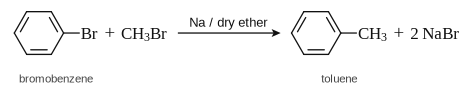
Mechanism of the Wurtz–Fittig Reaction
Na converts the more reactive halide into an organosodium / radical: CH3–Br + 2Na → CH3−Na+ + NaBr.

The aryl–sodium / alkyl species couples with the other halide. Net: aryl ipso carbon bonds to the alkyl carbon.
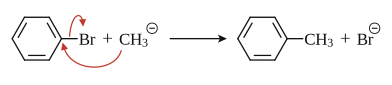
Shown in simplified ionic form (radical pathways also operate); no slow step is asked in JEE.
Shortcut to write the product
- Remove X from both partners and join aryl ipso-C to the alkyl C: Ar–X + R–X → Ar–R.
- If both halides are alkyl → it is Wurtz; both aryl → Fittig; one of each → Wurtz–Fittig.
JEE practice question
Ethylbenzene is obtained by the Wurtz–Fittig reaction from:
- C6H5Br + C2H5Br
- C6H5Br + CH3Br
- C6H5CH2Br + CH3Br
- C6H6 + C2H5Br
Show answer
Answer (a) — Wurtz–Fittig needs one aryl halide and one alkyl halide; Ph + C2H5 = ethylbenzene. (c) gives ethylbenzene too, but both are alkyl (benzylic) halides, so it is a Wurtz reaction; (d) is Friedel–Crafts.