Tishchenko Reaction
JEE AdvancedWhat is the Tishchenko Reaction?
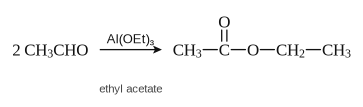
Aldehydes (with or without α-H) disproportionate in the presence of aluminium alkoxide (Al(OEt)3) to give an ester: one molecule is oxidised (acid part) and the other reduced (alcohol part). It is the Cannizzaro reaction carried out under non-aqueous Lewis-acid conditions, so the acid and alcohol remain joined as an ester.
Reagents and conditions
- Al(OEt)₃ (or Al(O-iPr)₃)
- anhydrous
- 2 RCHO → RCOOCH₂R
Example
Mechanism of the Tishchenko Reaction
An alkoxide (on Al) adds to one aldehyde to give an aluminium hemiacetal alkoxide (Al omitted below for clarity).

This alkoxide transfers a hydride to a second (Al-coordinated) aldehyde — slow step, exactly as in Cannizzaro.slow step
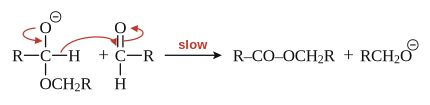
RCH2O−(Al) adds to the next aldehyde and the cycle continues; the ester accumulates.
Shortcut to write the product
- 2 R–CHO → R–CO–O–CH2–R: acid half + alcohol half of the same aldehyde joined as an ester.
- Cannizzaro (conc. NaOH, water) → separate salt + alcohol; Tishchenko (Al(OEt)3, dry) → ester.
JEE practice question
Benzaldehyde heated with aluminium ethoxide (anhydrous) gives mainly:
- benzyl benzoate
- sodium benzoate + benzyl alcohol
- benzoin
- ethyl benzoate
Show answer
Answer (a) — Tishchenko: one PhCHO becomes the acyl part, the other the benzyl part → C6H5COOCH2C6H5.