Named Reactions › Part A: Haloalkanes, Ethers & Organometallics
Swarts Reaction
JEE MainWhat is the Swarts Reaction?
Alkyl chlorides / bromides are converted into alkyl fluorides by heating with a metallic fluoride such as AgF, Hg2F2, CoF2 or SbF3.
Reagents and conditions
- AgF / Hg₂F₂ / CoF₂ / SbF₃
- heat
- R–Cl or R–Br → R–F
Example

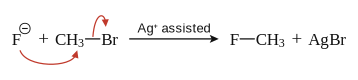
Mechanism of the Swarts Reaction
The metal ion pulls on the halogen (Ag+···Br) while fluoride bonds to carbon; net halogen exchange driven by the strong Ag–Br lattice. Simplified as one substitution step:
Shortcut to write the product
- Keep the carbon skeleton, replace Cl/Br by F. Reagent must be a metallic fluoride (not NaF, not aq. HF).
- Do not mix up: Finkelstein → iodide (NaI / acetone); Swarts → fluoride (AgF, SbF3).
JEE practice question
Freon-12 (CCl2F2) is manufactured from CCl4 by:
- Finkelstein reaction
- Swarts reaction
- Wurtz reaction
- Sandmeyer reaction
Show answer
Answer (b) — Cl → F exchange with SbF3 (SbCl5 catalyst) is a Swarts reaction.
📘 Study all 57 named reactions with mechanisms in the free 60 Minutes to JEE Named Reactions Handbook.