Knoevenagel Condensation
JEE AdvancedWhat is the Knoevenagel Condensation?
Aldehydes and ketones condense with compounds containing an active methylene group (Z–CH2–Z′, e.g. malonic ester, malonic acid, ethyl acetoacetate) in the presence of a weak base (pyridine, piperidine) to give α,β-unsaturated compounds. With malonic acid in pyridine the product also loses CO2 (Doebner modification).
Reagents and conditions
- CH₂(COOEt)₂ or CH₂(COOH)₂
- pyridine / piperidine (weak base)
- heat (−CO₂ with malonic acid)
Example

Mechanism of the Knoevenagel Condensation
The weak base removes a proton from the CH2 flanked by two C=O groups (very acidic) → stabilised carbanion.

The carbanion adds to the aldehyde carbonyl.
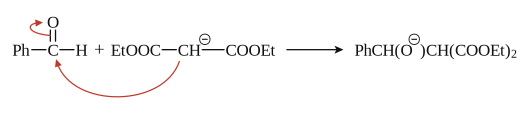
Protonation and dehydration → benzylidene compound; with malonic acid the β-dicarboxylic acid then loses CO2 on heating.

Shortcut to write the product
- C=O + H2C(Z)2 → C=C(Z)2 + H2O.
- Malonic acid + pyridine: also lose one COOH as CO2 → ArCH=CH–COOH (alternative to Perkin).
- Weak amine base is enough because the CH2 is very acidic; strong base would cause aldol/Cannizzaro side reactions.
JEE practice question
Benzaldehyde reacts with diethyl malonate in the presence of piperidine. The product is:
- PhCH=C(COOEt)2
- PhCH(OH)CH2COOEt
- PhCOCH(COOEt)2
- PhCH2CH(COOEt)2
Show answer
Answer (a) — Knoevenagel condensation: the active CH2 of malonic ester replaces the C=O oxygen → diethyl benzylidenemalonate (ester groups retained, so no decarboxylation).