Named Reactions › Part F: Rearrangements
Curtius Rearrangement
JEE AdvancedWhat is the Curtius Rearrangement?
Acyl azides (from acid chlorides + NaN3) on heating lose N2 and rearrange to isocyanates. Hydrolysis gives a primary amine with one carbon less; with alcohols, carbamates (urethanes) are formed.
Reagents and conditions
- RCOCl + NaN₃ → RCON₃
- heat (− N₂)
- H₂O → RNH₂ + CO₂ ; R′OH → RNHCOOR′
Example

Mechanism of the Curtius Rearrangement
Acyl azide formation (nucleophilic acyl substitution): RCOCl + N3− → R–CO–N=N+=N− + Cl−.

On heating, R migrates from C to N as N2 departs (concerted) → isocyanate. This is the slow, rate-determining step; a chiral R keeps its configuration.slow step
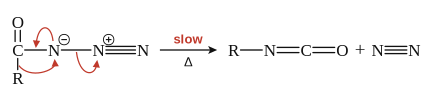
Water adds to the isocyanate → carbamic acid → amine + CO2. (Alcohol instead of water stops at the carbamate.)

Shortcut to write the product
- Same result as Hofmann: R–CO–X → R–NH2 (one carbon less), retention at R.
- Isocyanate + R′OH → R–NH–CO–OR′ (urethane); isocyanate + R′NH2 → urea.
- Family: Hofmann (Br2/OH− on amide), Curtius (acyl azide, Δ), Lossen (O-acyl hydroxamate), Schmidt (HN3/H+).
JEE practice question
Benzoyl azide (C6H5CON3) is heated under reflux in ethanol. The product is:
- C6H5NHCOOC2H5
- C6H5COOC2H5
- C6H5NH2
- C6H5CONHC2H5
Show answer
Answer (a) — Curtius gives phenyl isocyanate (Ph–N=C=O); ethanol adds across C=N → ethyl N-phenylcarbamate (a urethane).
📘 Study all 57 named reactions with mechanisms in the free 60 Minutes to JEE Named Reactions Handbook.