Named Reactions › Part E: Aldehydes & Ketones — Condensations
Claisen–Schmidt Condensation
JEE MainWhat is the Claisen–Schmidt Condensation?
A crossed aldol condensation between an aromatic aldehyde (no α-H) and an aliphatic aldehyde or ketone having α-H, in dilute alkali, gives an α,β-unsaturated carbonyl compound. Dehydration is spontaneous because the C=C is conjugated with both the ring and C=O.
Reagents and conditions
- ArCHO + CH₃COR (or RCH₂CHO)
- dil. NaOH, ethanol
- room temperature
Example
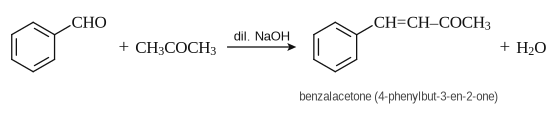
Mechanism of the Claisen–Schmidt Condensation
OH− removes α-H from acetone → enolate (benzaldehyde cannot form an enolate).

The enolate attacks the more electrophilic, unhindered aldehyde carbon of PhCHO.

Protonation, then fast E1cB dehydration gives the conjugated (trans) enone.

Shortcut to write the product
- ArCH=O + H2C(H)–COR → ArCH=CH–COR: replace the aldehyde O by the α-carbon (two H lost with O as water).
- Acetone has α-H on both sides: with excess ArCHO both sides react → dibenzalacetone (PhCH=CH)2C=O.
- PhCHO + CH3CHO → cinnamaldehyde PhCH=CHCHO.
JEE practice question
Benzaldehyde (2 mol) and acetone (1 mol) are shaken with dilute NaOH. The product is:
- PhCH=CHCOCH3
- (PhCH=CH)2C=O
- PhCH(OH)CH2COCH3
- PhCOOH + (CH3)2CHOH
Show answer
Answer (b) — Both CH3 groups of acetone carry α-H; with two equivalents of PhCHO, double Claisen–Schmidt gives dibenzalacetone.
📘 Study all 57 named reactions with mechanisms in the free 60 Minutes to JEE Named Reactions Handbook.