Benzoin Condensation
JEE AdvancedWhat is the Benzoin Condensation?
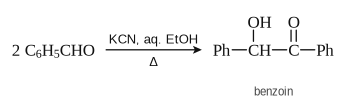
Two molecules of an aromatic aldehyde heated with aqueous ethanolic KCN (or NaCN) combine to form an α-hydroxy ketone (benzoin). Cyanide acts as a catalyst: it makes the carbonyl carbon of one aldehyde nucleophilic (umpolung).
Reagents and conditions
- ArCHO (no α-H)
- KCN / NaCN (catalytic)
- aq. ethanol, reflux
Example
Mechanism of the Benzoin Condensation
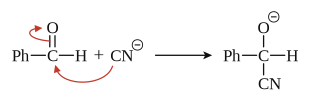
CN− adds to the aldehyde carbonyl → cyanohydrin alkoxide.
Proton transfer from C to O gives a carbanion stabilised by CN and the ring — the carbonyl carbon is now a nucleophile (umpolung).

The carbanion attacks the carbonyl carbon of a second aldehyde — slow, rate-determining C–C bond formation.slow step
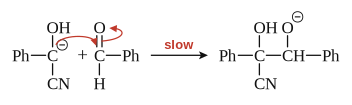
Proton transfer O→O, then the alkoxide re-forms C=O and expels CN− (catalyst regenerated) → benzoin.

Shortcut to write the product
- Join the two carbonyl carbons: one keeps C=O, the other becomes CH–OH → Ar–CO–CH(OH)–Ar.
- CN− is special: good nucleophile, stabilises the carbanion, good leaving group. Rate = k[ArCHO]2[CN−].
- Furfural → furoin; benzoin → (HNO3) benzil → (KOH) benzilic acid.
JEE practice question
In the benzoin condensation, cyanide ion is an effective catalyst because it:
- is a strong base that forms an enolate of benzaldehyde
- adds to C=O, stabilises the resulting carbanion and is a good leaving group
- oxidises benzaldehyde to benzoic acid
- reduces benzaldehyde by hydride transfer
Show answer
Answer (b) — Benzaldehyde has no α-H (no enolate). CN− must add, make the former carbonyl carbon carbanionic (umpolung) and finally leave — all three properties are needed.